Ammoniacum, Gum Ammoniacum
Armoniacum
Ushaka (Ayurveda)
Ushaq (Unani)

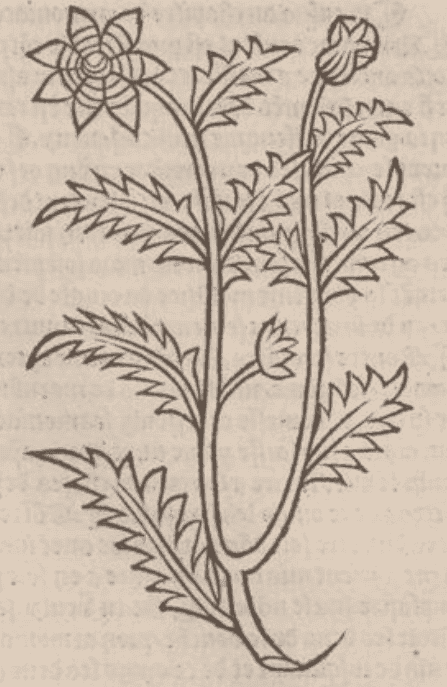
Ortus sanitatis, Cube, Johann von, 1501
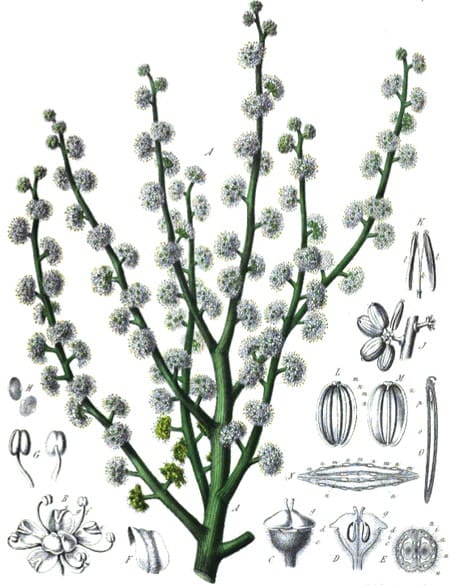
Atlas der officinellen pflanzen (2), Felix, 1899
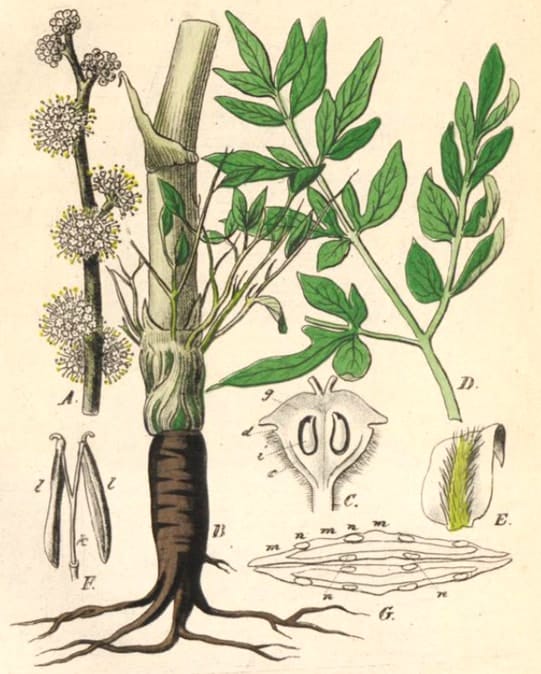
Dorema ammoniacum
Hand-Atlas Medicinisch-Pharmaceutischer, 1884
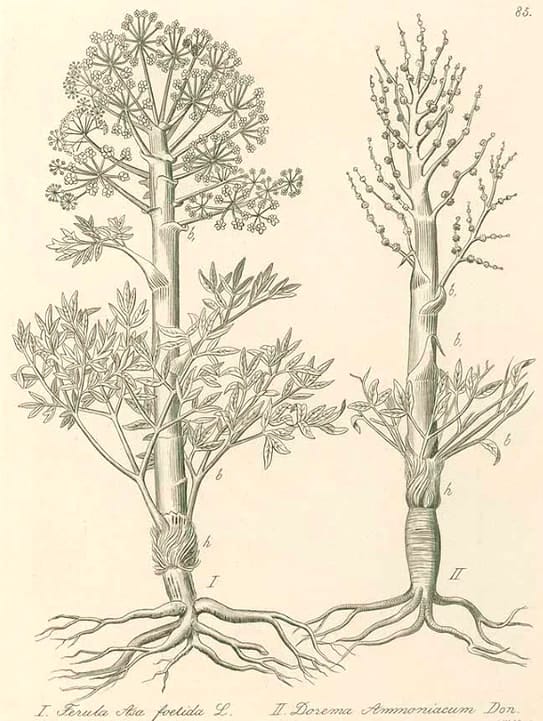
Asafetida (left) and Dorema (right), showing their close similarity (Kohl, F.G., Die officinellen Pflanzen der Pharmacopoea Germanica (1891-1895)
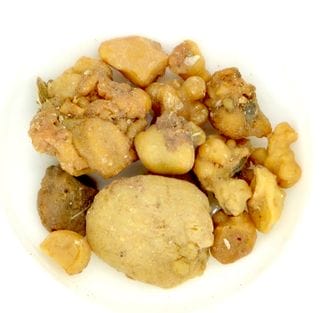
Gum Ammoniac (Adam, 2018)

Members CLICK HERE for the PRO VERSION
Botanical name:
Dorema ammoniacum (syn. Ferula ammoniacum)
Parts used:
Gum
Temperature & Taste:
Warm in the 2nd degree, dry in the 1st degree; Pungent
Classifications:
2A APERIENT 2D ATTENUATERS OF CONGEALED BLOOD 2I. ANTISPASMODICS 2K. RESOLVENT 2L. EMOLLIENT 2M. DRAWING
2U. SUPPURATIVES
3K. EXPECTORANT 3L. ANTI-TUSSIVE 3M. ARTHRITICS
4f. SPLENETIC 4k. ARTHRITIC
P. Clear Phlegm
Preparers and Purgers of Phlegm
Preparers and Purgers of Melancholy
Uses:
1. Clears Cold-Phlegm, Dries Damp:
-chronic Cough, Wheezing, Shortness of Breath from Cold Phlegm
2. Clears Phlegm, Resolves Swellings:
-Opens obstructions of the Spleen and Liver
3. Clears Wind-Damp, Promotes Urine:
-Edema
4. Moves the Blood, Promotes Menstruation
–Amenorrhea, Dysmenorrhea;
5. Externally:
-Topically for Joint Pain
Dose:
Preparation:
Correctives

Main Combinations:
1. Cough, Asthma, Shortness of Breath,
i. Gum Ammoniac with … available in PRO version
ii. Gum Ammoniac with … available in PRO version
iii. Gum Ammoniac with … available in PRO version
iv. Gum Ammoniac with … available in PRO version
v. Gum Ammoniac with … available in PRO version
vi. Shortness of Breath, Gum Ammoniac (2 drams), … available in PRO version
vii.. Cough and Lung diseases from Phlegm, Gum Ammoniac with … available in PRO version
viii. Asthma, Gum Ammoniac with … available in PRO version
2. Phlegm obstructing the Lungs:
i. Gum Ammoniac, … available in PRO version
ii. Gum Ammoniac, … available in PRO version
iii. Gum Ammoniac, … available in PRO version
3. To promote Menstruation and resolve obstructions of the Uterus:
i. Gum Ammoniac with … available in PRO version
ii. Gum Ammoniac with … available in PRO version
iii. Gum Ammoniac with … available in PRO version
4. to clear Damp, promote Urine and open Obstructions; Edema, obstructed Urine:
i. Gum Ammoniac with … available in PRO version
ii. Gum Ammoniac with … available in PRO version
iii. Gum Ammoniac with … available in PRO version
iv. Gum Ammoniac with … available in PRO version
v. Urinary retention, Gum Ammoniac with … available in PRO version
5. Ascites, Gum Ammoniac with … available in PRO version
6. Obstruction or Hardness of the Liver or Spleen:
i. Gum Ammoniac, … available in PRO version
i. Gum Ammoniac … available in PRO version
ii. dissolve Ammoniac … available in PRO version
7. Apoplexy, Gum Ammoniac, … available in PRO version
8. Wind-Damp Joint Pain, Sciatica:
i. Gum Ammoniac with … available in PRO version
ii. Gum Ammoniac with … available in PRO version
9. Scrofula, ganglions and swollen nodes:
i. combine Gum Ammoniac with … available in PRO version
ii. Gum Ammoniac with … available in PRO version
10. Worms, Gum Ammoniac … available in PRO version
11. Plaster for Hardness:
i. mix Gum Ammoniac with … available in PRO version
ii. Gum Ammoniac with … available in PRO version
Major Formulas:
Troches Praised for Liver Hardness (Nicholas)
Foetid Pills Minor of Galen
Pills for Apoplexy (Arnold de Villa Nova)
Pills of Seeds (Unani)
Pills for Fibrosis of the Liver (Riverius)
Pills for Retention of Urine (Wirtzung)
Pills of Rhubarb (Greater) (Pil. de Raved Sceni) (Mesue)
Electuary of Gums (Zenon)
Hiera Logadii
Cautions:
1. Very drying, not suitable in Yin deficiency
2. Not used during Pregnancy
3. Excess use can cause Hematuria
Main Preparations used:
Distilled Oil, Pills of Ammoniacum, a Resinous Extract
Pliny on Gum Ammoniac:
‘Of a similar nature to galbanum is hammoniacum, a tear like gum, the qualities of which are tested in manner already stated. It is of an emollient, warming, resolvent, and dispellent nature. Employed as an ingredient in eye-salves, it improves the sight. It disperses prurigo, effaces the marks of sores, removes spots in the eyes, and allays tooth-ache, more particularly when burnt. It is very useful too, taken in drink, for hardness of breathing, pleurisy, affections of the lungs, diseases of the bladder, bloody urine, maladies of the spleen, and sciatica: employed in a similar manner, it acts as a purgative upon the bowels. Boiled with an equal proportion of pitch or wax, and with oil of roses, it is good for diseases of the joints, and for gout. Employed with honey it ripens hard tumours, extracts corns, and has an emollient effect upon in durations. In combination with vinegar and Cyprian wax, or oil of roses, it is extremely efficacious as a liniment for affections of the spleen. In cases of extreme lassitude, it is an excellent plan to use it as a friction, with vinegar and oil, and a little nitre.’ (The Natural History of Pliny, trans. by Bostock and Riley, Vol. 5, 1856)
Pliny on Gum Ammoniac:
‘Of a similar nature to galbanum is hammoniacum, a tear like gum, the qualities of which are tested in manner already stated. It is of an emollient, warming, resolvent, and dispellent nature. Employed as an ingredient in eye-salves, it improves the sight. It disperses prurigo, effaces the marks of sores, removes spots in the eyes, and allays tooth-ache, more particularly when burnt. It is very useful too, taken in drink, for hardness of breathing, pleurisy, affections of the lungs, diseases of the bladder, bloody urine, maladies of the spleen, and sciatica: employed in a similar manner, it acts as a purgative upon the bowels. Boiled with an equal proportion of pitch or wax, and with oil of roses, it is good for diseases of the joints, and for gout. Employed with honey it ripens hard tumours, extracts corns, and has an emollient effect upon in durations. In combination with vinegar and Cyprian wax, or oil of roses, it is extremely efficacious as a liniment for affections of the spleen. In cases of extreme lassitude, it is an excellent plan to use it as a friction, with vinegar and oil, and a little nitre.’ (The Natural History of Pliny, trans. by Bostock and Riley, Vol. 5, 1856)
Vegetable Materia Medica of Western India, Dymock, 1885:
Two species of Dorema, D. ammoniacum and D. Aucheri, Botes., both natives of Persia, are known to produce a gum-resin identical with the commercial article, and it is probable that some of the other species also contribute a portion of the ammoniacum of trade.
Dioscorides speaks of ammoniacum as the juice of a narthex growing about Cyrene in Libya, and it appears to have derived its name from the temple of Ammon. Pliny derives it from ‘Ammos,’ sand. Most Greek and Latin writers on medicine mention its use in fumigation, and speak of it as Thus Libycurn, ammoniacum thymiana, or ammoniacum suffimen. This kind of ammoniacum has now been ascertained to be the gum-resin of Ferula Tingitana, Linn., which grows in Morocco. It was probably the only kind known in Europe in olden times. (Confer. Pharma-cographia, p. 288.) The time when Persian ammoniacum first came into use cannot be exactly fixed.
It is not mentioned by the Greeks or Romans. Ibn Sina states that Ushak is the gum of the Tarthuth, and is called Lazak-el-dahab because it is used in gilding. His ammoniacum is doubtless Persian, like that of Abu Masur Mowajik, a Persian physician of the eleventh century, and of Ansari of the middle of the fourteenth century. The latter writer states that the Shirazi name for Ushak is Badian. In Bokhara the gum-resin bears the name Kandal. According to Bunge and Bienert, the same name, and Kamak, are given to the plant in Persia; whilst Wright gives Weschak, and Dr. Buhse Oschak, as the true names of the plant in that country.
According to Borszczow, D. ammoniacum is called by the Kirghises Bal-kurai or “Honey-cane.” (E. Hirschsohn Phar. Zeitschrift fur Russland, April 15, 1875, p. 225.) The author of the Makhzan-el-Adwiya says that Ushak is an Arabic corruption of the Persian Ushnah or Ooshah, and that the drug is also called Kalbani, and in Arabic Ushajj, Wushajj, Wushak and Lazak-el-Dahab. He gives the Greek names as Athanikun, Ammoniakun and Parnaksh, the Egyptian as Kinna, Shak and Kalakh, and the Indian as Kandar. Some Persian writers give Tarthdth as the Arabic and Samgh-i-bal-i-shirin as the Persian name. According to the dictionaries, Bal is the Persian for Tarthuth. Baghdadi tells us that Tarthuth is not the same as ammoniacum. In Bombay the current Persian name is Ushak. The Hindu brokers generally call it ammoniacum. Mahometan works on Materia Medica describe the drug as discutient and attenuant; for more particular opinions respecting it the reader may consult the Makhzan-el-Adwiya, article Ushak. Sanskrit writers do not mention it. Besides the gum-resin, the root of D. ammoniacum is largely imported into Bombay, and is one of the substances used by the Parsees as incense under the name of Boi, a word cognate with Bu, or Bo, fragrance. It is popularly spoken of as a wood. There can be little doubt that the use of this substance as an incense must date from a very remote period, otherwise the modern Parsees would not be at the trouble of importing it into India. Mr. K. R. Cama informs me that the “wood of fragrant trees” is mentioned in the Avesta as a class, and that one wood in particular is named, “Hadha Naeptanam,” which would mean translated into Persian, “Hamisheh naft,” always moist, i.e., green. He says: “In modern days we identify this wood, most likely mistakenly, with Pomegranate wood.” It would appear then, that there is no specific description of Boi in the Avesta, but that it is traditionally understood to be one of the fragrant woods mentioned therein. It is this root which was some years ago exported to Europe as Bombay Sumbul, after having been cut up and impregnated with musk. When old and worm-eaten it becomes of a loose and spongy texture, and might easily be mistaken for Sumbul by a superficial observer.’
GENERAL / REVIEW
–Ethnomedicinal Uses, Phytochemistry and Pharmacology of Dorema Species (Apiaceae): A Review
–The emulsifying and foaming properties of Amuniacum gum (Dorema ammoniacum) in comparison with gum Arabic
–Ethnobotanical knowledge of Apiaceae family in Iran: A review
ANTIOXIDANT
–Phytochemical Analysis, In Vitro Anticholinesterase, Antioxidant Activity and In Vivo Nootropic Effect of Ferula ammoniacum (Dorema ammoniacum) D. Don. in Scopolamine-Induced Memory Impairment in Mice
–Purification, structural characterization and antioxidant activity of a new arabinogalactan from Dorema ammoniacum gum.
ANTICONVULSANT
–Neuro-Behavioral Profile and Toxicity of the Essential Oil of Dorema ammoniacum Gum as an Anti-seizure, Anti-nociceptive, and Hypnotic Agent with Memory-enhancing Properties in D-Galactose Induced Aging Mice
–Anticonvulsant activity of Dorema ammoniacum gum: evidence for the involvement of benzodiazepines and opioid receptors
HYPNOTIC
–Neuro-Behavioral Profile and Toxicity of the Essential Oil of Dorema ammoniacum Gum as an Anti-seizure, Anti-nociceptive, and Hypnotic Agent with Memory-enhancing Properties in D-Galactose Induced Aging Mice
EPILEPSY
–Effects of Dorema ammoniacum Gum on Neuronal Epileptiform Activity-Induced by Pentylenetetrazole
–Ameliorating Effects of Dorema ammoniacum on PTZ-Induced Seizures and Epileptiform Brain Activity in Rats.
ENHANCES MEMORY
–Neuro-Behavioral Profile and Toxicity of the Essential Oil of Dorema ammoniacum Gum as an Anti-seizure, Anti-nociceptive, and Hypnotic Agent with Memory-enhancing Properties in D-Galactose Induced Aging Mice
ACETYLCHOLINESTERASE INHIBITOR
–Compounds from Gum Ammoniacum with Acetylcholinesterase Inhibitory Activity
–Phytochemical Analysis, In Vitro Anticholinesterase, Antioxidant Activity and In Vivo Nootropic Effect of Ferula ammoniacum (Dorema ammoniacum) D. Don. in Scopolamine-Induced Memory Impairment in Mice
BENIGN PROSTATIC HYPERPLASIA:
–Evaluation of the Therapeutic Effect of the Traditional Herbal Medicine Atrifil and Oshagh Gum on Testosterone-Induced Benign Prostatic Hyperplasia in Wistar Rats.
ANTI-CANCER:
–Anti-Cancer Effect of Dorema Ammoniacum Gum by Targeting Metabolic Reprogramming by Regulating APC, P53, KRAS Gene Expression in HT-29 Human Colon Cancer Cells.
–Evaluation of the Cytotoxicity of Aqueous Extract and Oleo-Essential Oil of Dorema ammoniacum Plant Oleo-Gum Resin in Some Human Cancer Cell Lines.
WOUND HEALING:
–Determination of the effectiveness of Dorema ammoniacum gum on wound healing: an experimental study.