Astroites, Star Stone
Witch Stones
Astrion, Asterites, Astrochites, Astroitis (Star stone), Lapis Stellae magis (stone of many stars), Stellaris lapis, Stellæ lapis, Lapis Stellatus (starry stone), Astroitis verum (True star stone), Stellaria Astroitidis (Star star)
These stones are fossilized limestone skeleton of ancient motherpores or marine polyperos (colonial Corals)
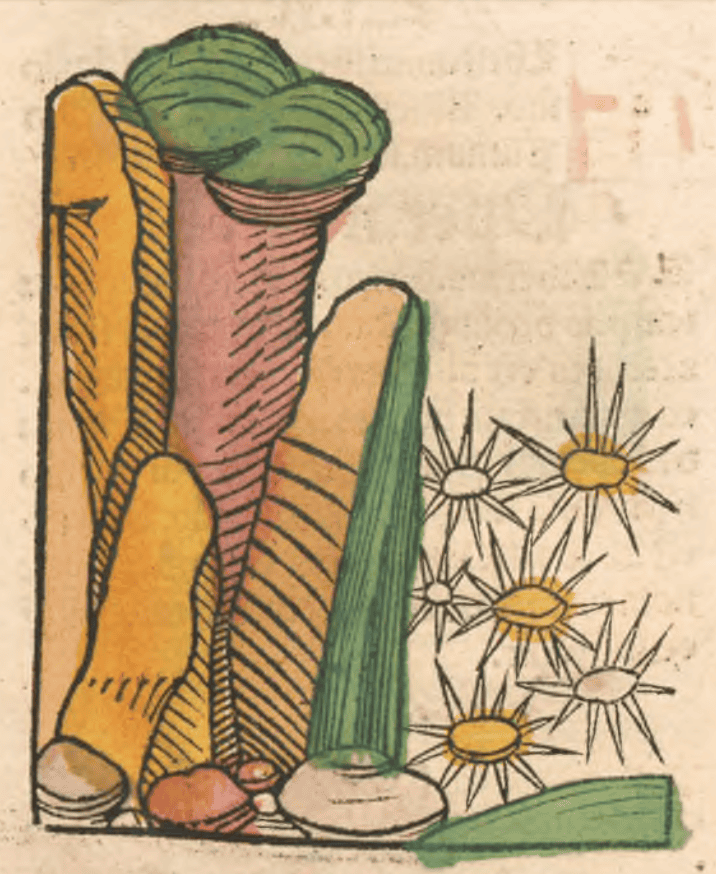
Hortus sanitatis, 1491
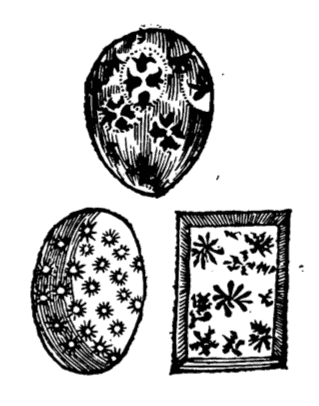
Museum Wormianum, 1655
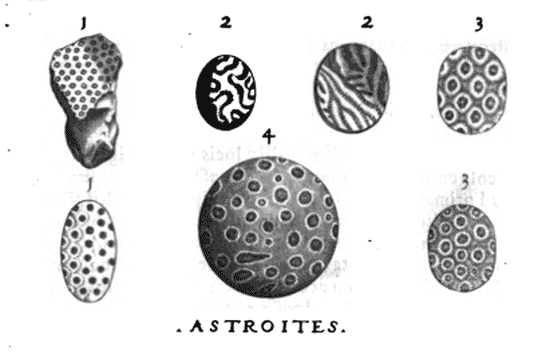
Metallotheca Vaticana, Mercati, 1719
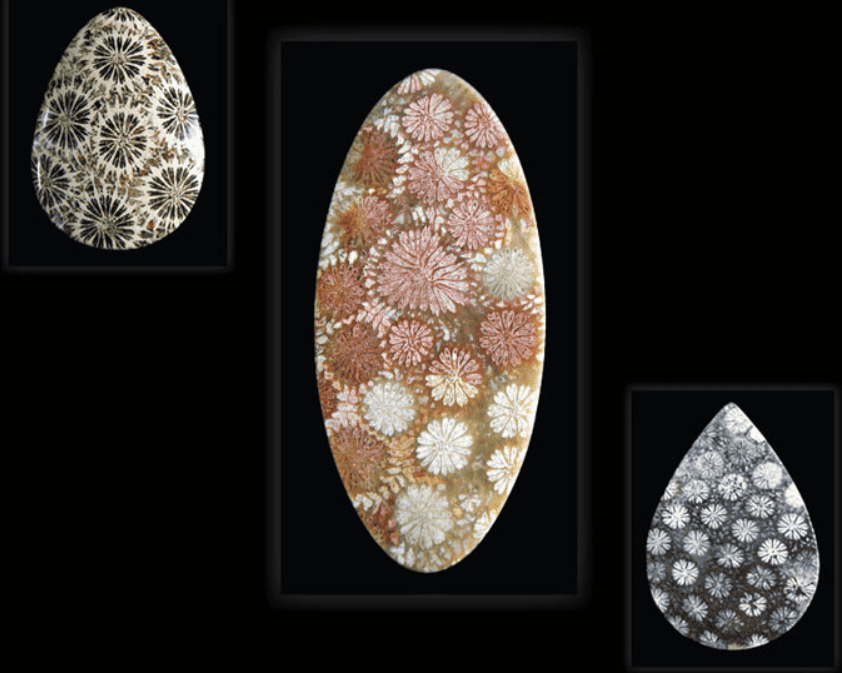
Examples of Fossil Corals used as ‘Star Stones’
Photo by Irwan Holmes
Salmon, Seplasium:
“It is called Asterios Lithos, Astroites, Asteria, Astrites, and Star Stone. It is a dark stone of a whitish color, full of stars or Roses, sometimes like waves of water. Boetius thought it to be a type of Agate.
“There are 3 main types: 1. Round, without any stars in it; 2. Round, and full of stars; 3. The third has diverse stars longitudinally and may be separated by hand or instrument. They can be very large, but are often no broader than a finger nail. Salmon said the Toad Stone was a species of Star Stone.”
They were sold for 10 shillings a piece in Salmon’s day (17th century) and were often set in rings of Gold.
Star Stone powdered finely and given in doses of 4–6 grains was accounted excellent for the Plague, to expel Worms, and for Vertigo and Apoplexy. It was also commended for Melancholy, and to strengthen the principle parts (Brain, Heart and Liver). It is highly alkaline so counters excess acidity in the body.
It was called Witch Stone as it was believed to protect from the Spells of Witches.
Vollständiges Materialien Lexicon, Lemery (1721):
Asteria.
Astroites.
A star stone.
French, Pierre Etaille.
German, Sternstein.
It is a dense and flat, dark stone, of various shapes and sizes, white or ash-colored, gray or brown. Many consider this stone a precious stone because it is commonly used in rings. There are four different varieties.
The first, and the one on the right, is covered with a cluster of little stars, which are full of holes and are carved into it so artfully by nature, as if the most skilled artist had painstakingly placed them there.
The other represents roses and other figures. Broad, perforated, or spongy stripes run across the third, winding like streams. It is therefore called the Astroites undulatus.
The fourth is the worst, and there are more confused spots on it than stars to be seen.
These stones are frequently found in the county of Tyrol and elsewhere; sometimes they are as large as a man’s head. If, out of curiosity, one treats them with vinegar or something else acidic, they move. Because they are full of tiny holes and therefore alkaline, the tiny points of these acidic substances penetrate into and through them, shaking them.
All sorts of powerful virtues are attributed to this star stone, such as helping against the plague and other contagious diseases; expelling and killing worms, purifying the blood, and preventing stroke. However, nothing more can be said of it than its ability to evaporate acid in the body and stop phlegm and hemorrhages, as other alkaline substances also tend to do. The dose is from fourteen grains to one scruple”.