Coral, Shan Hu 珊瑚
Praval (Ayurveda)
Marjun (Unani)
Shan Hu (TCM)
Byu ru བྱུ་རུ, Jumar (Tibetan)

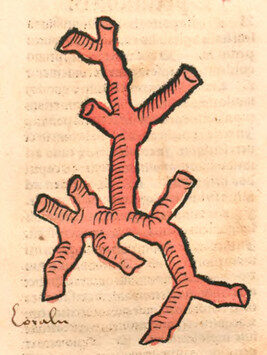
Hortus sanitatis, 1491
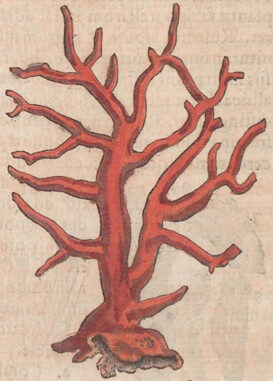
Gesner, De Rerum fossilium, 1565
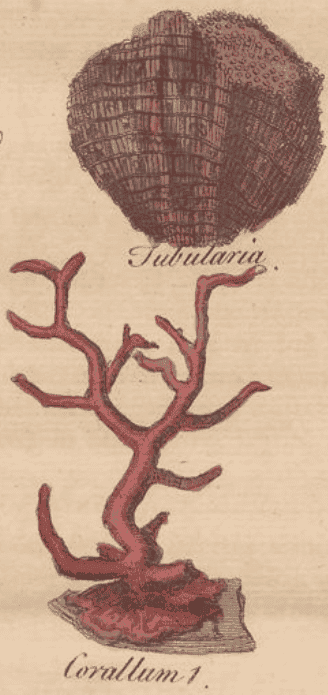
Two main varieties of Red Coral used in medicine including Pipe Coral (top)
A History of Plants, Hill, 1751
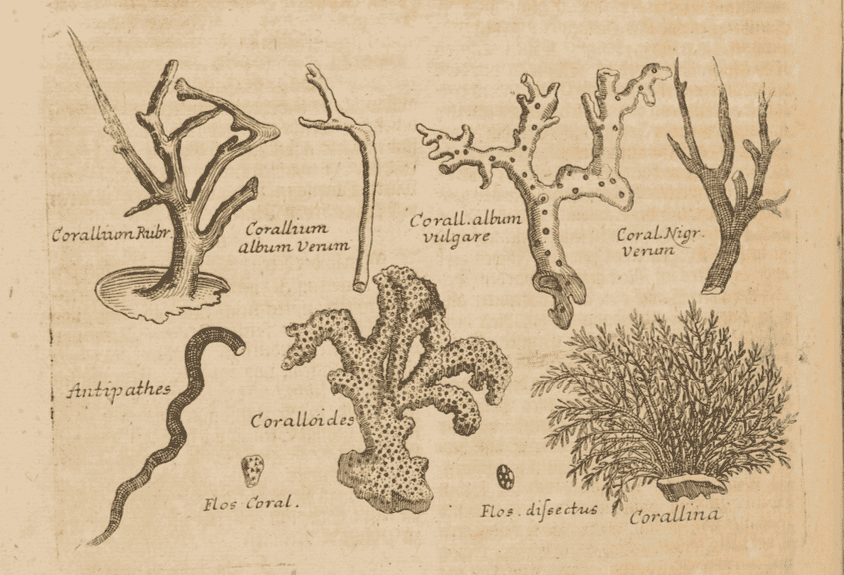
Various Coral species, including Corallina, dealt with elsewhere (bottom right)
Museum Museorum, Valentini, 1704
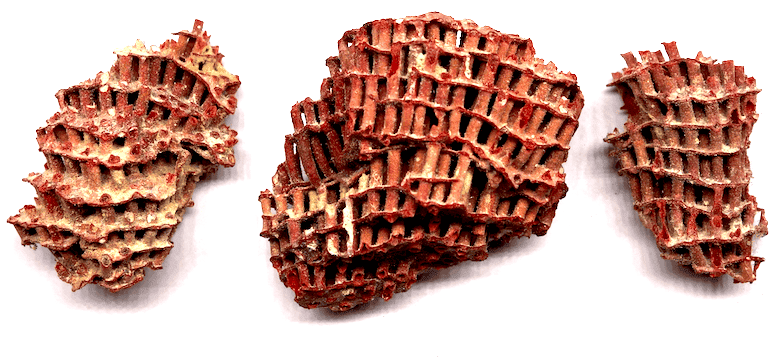
Red Pipe Coral
This is more commonly used today due to it being found on beaches rather than harvested from reefs
(Calcutta Unani Medicine College, Adam, 2019)
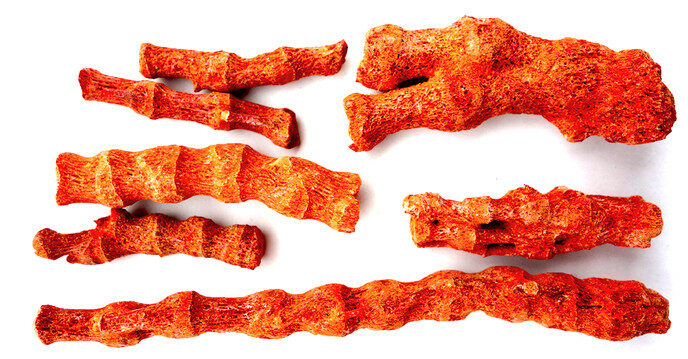
Red Coral collected from beaches (Adam, 2019)

Members CLICK HERE for the PRO VERSION
Zoological Name:
Various red species of red Coral:
- Corallium rubrum (syn. C. nobile, Madrepora rubrum)
- Corallium konojoi
- Tubipora musica (Pipe Coral)
Other types of Red Coral are also used including the Japanese C. japonicum.
White Coral is also used, but less commonly.
Parts used:
Red and White Coral; Red Coral roots are also used in Ayurveda and Unani medicine.
They are either prepared or burnt.
Only Coral found washed up on shores should be used.
Temperature & Taste:
Cold, dry. Salty, sweet.
Constituents:
Primarily Calcium carbonate (CaCO3) 87%, Calcium carbonate 6%, Magnesium carbonate 1.2%, Calcium sulphate 1.7%, Ferrous oxide 1.3%, and traces of more than 70 minerals.
Over 100 organic matrix proteins, scleritin being most common;
Glycoproteins; sugar-binding Proteins, Collagen-like proteins
Properties:
Hardness: 3.5–4
Classification:
Uses:
1. Clears Heat, Stops Bleeding, Stops Leakage (West, Ayurveda, Tibetan Medicine):
-Bleeding from Heat
2. Clears Heat, Stops Wind, Settles Spasms:
-chronic Headaches and Brain and Nervous diseases (West, Tibet, Unani, TCM)
3. Calms the Spirit, Benefits the Heart: (West, TCM, Ayurveda, Tibetan Medicine):
-Insomnia, excess Dreaming
4. Clears Heat, Cools the Blood, Resists Poison:
-various types of Fever
5. Clears Stomach Heat, Neutralises Acid (West, Ayurveda, Unani):
-antacid in acid reflux, indigestion and vomiting.
6. Clears Heat, Stops Coughs (West, Ayurveda, Tibetan Medicine):
7. Benefits the Yin, Restrains Leakage (West, Ayurveda, Tibetan Medicine):
-debility and deficiency
8. Externally:
-Worn to Cool, benefit the Heart, and resist Poison
Dose:
Preparation:
Correctives:
Substitutes:
Comment:

Main Combinations:
Heart
1. Heart weakness:
i. Red Coral, … available in PRO version
ii. Comfort the Heart Yin, clear Heart from the Heart, Red Coral … available in PRO version
2. Palpitation,
i. Red Coral with … available in PRO version
ii. Red Coral with … available in PRO version
iii. Red Coral with … available in PRO version
Head, Brain and Nerves:
3. Strengthen the Head, Mental Weakness or Dullness, Anxiety Restless, Red Coral … available in PRO version
4. Headache from Wind, Red Coral with … available in PRO version
5. Melancholy, Dementia, Red Coral, … available in PRO version
6. Obsession, Charms, Nervousness, Melancholy, Red Coral with … available in PRO version
7. Epilepsy:
i. Red Coral, … available in PRO version
ii. Red Coral, … available in PRO version
iii. Epilepsy, Dizziness, Panic disorder, Red Coral, … available in PRO version
8. Red Coral … available in PRO version
Leakages and Bleeding:
9. Diarrhea:
i. Red Coral with … available in PRO version
ii. Red Coral with … available in PRO version
iii. Coral … available in PRO version
10. Heat-type Bleeding:
i. Red Coral with … available in PRO version
ii. Vomiting Blood following Trauma, … available in PRO version
11. Hemopytsis:
i. Red Coral (2 parts), … available in PRO version
ii. Red Coral with … available in PRO version
iii. Red Coral with … available in PRO version
iv. Red Coral (1 scruple), … available in PRO version
v. Red Coral with … available in PRO version
vi. Red Coral, … available in PRO version
vii. Red Coral, … available in PRO version
12. To prevent Miscarriage:
i. Red Coral with … available in PRO version
ii. Red Coral with … available in PRO version
Other:
13. Ruptures (Hernias), Red Coral with … available in PRO version
14. Back weakness, Red Coral with … available in PRO version
15. Spermatorrhea, … available in PRO version
15. As a Yin Tonic, Red Coral with … available in PRO version
External:
16. Tooth powder, Red Coral with … available in PRO version
17. Swelling and bleeding of the Gums, Red Coral topically with … available in PRO version
18. A traditional ‘Cordial Shield’ against Swooning: … available in PRO version
Major Formulas:
Troches of Coral (Galen)
Troches of Coral (Diacorallium) (Nicholas)
Electuary of Coral (Diacorallion) (Nicholas)
Cooling Powder of Gems
Red Hungarian Powder
The White Powder
The Goa Stone
Powder of Gems for Palpitations (Wirtzung)
Powder to Strengthen the Head
Powder for Cold Diseases of the Head (Renodeus)
Powder for Bleeding from the Stomach (Nicolas)
Troches for Heart Weakness
Pills to Prevent Miscarriage (Wirtzung)
Cautions:
Generally Safe. It is heavy and cold, and hard to digest. It should be used cautiously in cold and weak digestion.
Toxicity:
Doses of up to 2000mg/kg in rats had no ill effect.
CITES listing:
Red Coral is listed on CITES as endangered and trade is generally forbidden. The trade that mostly endangers Coral is for jewellery. Large pieces of gem quality Red Coral fetch high prices and this mostly feeds illicit trade. However, lower quality and non-gem quality red coral, especially Pipe Coral, can be commonly found on tropical beaches. Further, direct communication with the head office of CITES in Europe confirmed that Red Coral Powder or “Coral Sand” is not covered under the convention. Therefore, trade in Red Coral powder as used in medicine is neither a predominant factor in making Red Coral endangered, nor is it prohibited by the CITES international convention.
Main Preparations used:
Prepared (levigated) Powder
Dioscorides:
‘Coral seems to be a sea plant which hardens when it is drawn out of the deep — taken out of the sea and as it were, dipped into the air flowing all around us. Great amounts of it are found in the promontory called Pachynum near Syracuse. The best is red like sandarac or sandyx [very red], a very intense colour. This is easy to pound; even throughout its whole concretion, with a mossy smell like little seaweed, and with many branches, imitating cinnamon in the form of little shrubs. That hardened like stone, rough, without colour, hollow and loose, is thought to be worthless. By its strength it is therapeutic for the bowels, cools gently, represses abnormal growths, takes off scars on the eyes, fills up hollow sores and cracks, works effectively against spitting up blood, is good for frequent painful urination, and (taken as a drink with water) reduces the spleen. Some have called it lithodendron‘.
Salmon, Seplasium:
It is called Bassad, Besed, Bassath, Belisis and Morgen in Arabic; in Greek, Korallion, Lithodendron and Georgeia; in Latin Corallium, Corallum; Pliny calls it Cirolium, Caerulium, Dendrites, Sandastrum; in English, Coral.
There are three main colors: White, Black and Red. The red came from East Indies, the Tyrrhene and Sicilian Sea and came chiefly out of Italy. The White was found in the West Indies, Spain, France and on the west coast of England. The Black was from Spain.
The deep red is best, the paler types being less good. The clear, clean White is next best.
It is levigated very finely on a marble; it is cool, dry and binding, strengthens the Heart, Stomach and Liver, absorbs acidity, purifies the Blood, resists Plague, Epidemics and Poison. It stops leakages from the Bowels, Womb or Urinary tract, prevents and cures Dysentery, Gonorrhea and Spermatorrhea, Leukorrhea. Used for Epilepsy in children, 10 grains being given with mothers milk.
It stops Bleeding, helps difficult Urination, eases the Spleen and is prevalent for the pain of Bladder stones.
Topically it helps Ulcers, fills them with flesh, and cicatrizes. In Collyriums it helps the eyes, stops tearing and strengthens the Eyesight.
Dose is 1 scruple to 1 dram in a suitable vehicle.
From it were prepared a Tincture, Syrup, Salt and Magistery. The Arabs had some compound medicines based on Coral.
GENERAL / REVIEW
–Ethno-Pharmacological Profile of Corallium Rubrum L., an Important Marine Drug, in the Unani System of Medicine
–Arginine Kinases from the Precious Corals Corallium rubrum and Paracorallium japonicum: Presence of Two Distinct Arginine Kinase Gene Lineages in Cnidarians.
–Ethnopharmacological study of natural products used for traditional cancer therapy in Algeria
–Healing with animals in the Levant from the 10th to the 18th century
–Characterization of the proteinaceous skeletal organic matrix from the precious coral Corallium konojoi
–PAVALAM: A VALUABLE SIDDHA MINERAL DRUG
–A POTENTIAL SIDDHA MINERAL DRUG; PAVALAPARPAM
PREPARATION
–In-house preparation and characterization of an Ayurvedic bhasma: Praval bhasma.
ANTIBACTERIAL
–PAVALAM: A VALUABLE SIDDHA MINERAL DRUG
HEMOSTATIC
–PAVALAM: A VALUABLE SIDDHA MINERAL DRUG
HYPERACIDITY
–PAVALAM: A VALUABLE SIDDHA MINERAL DRUG
HEPATOPROTECTIVE
–PAVALAM: A VALUABLE SIDDHA MINERAL DRUG
MENOPAUSE
–Clinical evaluation of Ashokarishta, Ashwagandha Churna and Praval Pishti in the management of menopausal syndrome.
OSTEOPOROSIS
–Effect of Praval bhasma (Coral calx), a natural source of rich calcium on bone mineralization in rats.
–PAVALAM: A VALUABLE SIDDHA MINERAL DRUG