Eupolyphaga, Tu Bie Chong 土鳖虫
Ground Beetle, Wingless Cockroach
Tu Bie Chong (TCM)

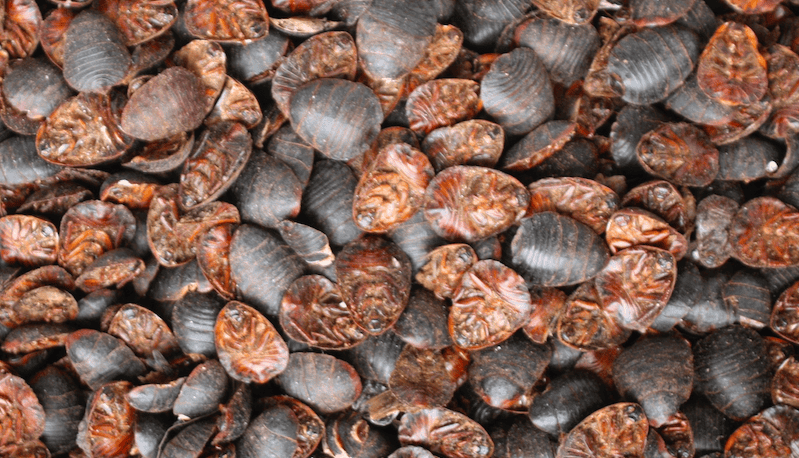
Tu Bie Chong
(Adam, Chengdu Medicine Market, 2009)
Entomological name:
Eupolyphaga sinensis is the official species.
Other species supplying the market include:
- E. thibetana (found in Tibet)
- E. yunnanensis (found in Yunnan and Vietnam)
- E. everestians (found on Mt. Everest)
- Polyphaga plancyi (syn. Steleophaga plancyi) (found throughout China)
- Opisthoplatia orientalis (found in China, Taiwan, Japan, India, and Indonesia
Eupolyphaga sinensis is preferred for farming for medicinal use as it is oviparous, diseases-resistent, more caopable of being farmed and has a wider food source. However, other of the above species are used locally when available. Opisthoplatia orientalis has a better taste, however.
Parts used:
Whole dried female insect
Temperature & Taste:
Cold, dry. Salty. Slightly Toxic,
Constituents:
Nutrient rich: Proteins (21–54 g/100 g dry weight), lipids (33.40 g/100 g dry weight), volatile compounds (37 in number), alkaloids (7 in number), essential fatty acids, vitamins, trace minerals (1–7 g/100 g dry weight)
Classifications:
Uses:
1. Strongly Moves the Blood, Clears Stasis:
-Amenorrhea, Dysmenorrhea
-Postpartum Blood Stagnation
-Abdominal Masses, Fibroid Tumors, Cancer
-enlarged Liver, or Hardness of the Liver or Spleen, Liver Fibrosis, Crirrhosis
-poor Memory and Epilepsy from poor cerebral circulation
-regarded as one of the strongest ‘Blood-breaking’ medicine in TCM
-“blood accumulations, concretion-illness and conglomeration-illness. They break open hardenings, and discharge blocked blood”. (Ben Cao Gang Mu)
-“very good at helping one give birth to children”. (Ben Cao Gang Mu)
-“Blood accumulation following childbirth”. (Ben Cao Gang Mu)
2. Moves the Blood, Promotes Healing of the Sinews and Bones:
-Trauma, Bruising
–Lumbar sprain, other sprains and strains
-Injury to the soft tissue of the joints, Fractures
Dose:
Decoction: 3–9 grams
Powder: 500–1500mg
Tincture (1:5 in 90% alcohol): 2–5 mls.
Comment:
This is a potent medicine to move the Blood, regarded as similar in strength to Leech which contains powerful anticoagulants. However, this is regarded as more suitable for weak patients.
Preparation:
It is important to use heat to sterilize them before use if used in powders or pills.
1. Typically, they are killed with boiling water, then dried in the sun or a low oven.
2. Dry-fried Wingless Cockroach (Chao Tu Bie Chong)
Dry fry in a wok until scorched. This reduces toxicity, helps sterilize and reduces the foul smell.
Substitute:
I. Pill Millipede has been used in the West very similarly to Eupolyphaga in TCM. It can be used as a substitute, especially for Masses and Tumors associated with Blood Stasis.
2. Wingless Cockroach is used as a substitute for Pangolian scales (Chuan Shan Jia) when used to break blood stasis and resolve masses.
Main Combinations:
1. Blood Stasis:
i. Eupolyphaga with Rhubarb (Da Huang), Dang Gui, Leech (Shui Zhi), Tabanus (Meng Chong), Toxidendron resin (Gan Qi), Peach kernel (Tao Ren), Scutellaria Huang Qin, Paeonia Bai Shao, Rehmannia Sheng Di Huang, Apricot kernel (Xing Ren), Licorice (as in Da Huang Zhe Chong Wan)
ii. to strongly resolve Blood Stasis, Eupolyphaga with Leech (Shui Zhi), Earthworm (Di Long)
2. Abdominal Masses:
I. Eupolyphaga with Rhubarb (Da Huang), Peach kernel (Tao Ren). (This is called Xia Yu Xue Tang)
ii. Eupolyphaga with Leech (Shui Zhi), Tabanus Meng Chong, Paeonia Mu Dan Pi, Zedoary (E Zhu), Rhubarb (Da Huang), Peach kernel (Tao Ren), Safflower (Hong Hua)
3. Enlarged Liver or Hardness of the Liver, Eupolyphaga with Curcuma Yu Jin, Notoginseng San Qi
4. Cirrhosis:
i. Eupolyphaga with Cremastra Shan Ci Gu
iI. Eupolyphaga with Paeonia Mu Dan Pi, Rhubarb (Da Huang), Peach kernel (Tao Ren).
5. Gynecological Tumors, Eupolyphaga with Zedoary (E Zhu)
6. Postpartum Abdominal Pain from Blood Stasis, Eupolyphaga (20 in number), Peach kernel (Tao Ren) (20), Rhubarb (Da Huang) (6 grams). Form 4 pills with Honey. Simmer one pill is wine and drink the warm decoction. (Zhang Zhong Jiang Fang, TCM)
7. Severe pain from Gout or Arthritis, Eupolyphaga with Wasp Nest (Feng Fang), Centipede (Wu Gong), Spatholobus Ji Xue Teng
8. Cerebrovasular Accident (CVA), Cerebral Ischemia, Eupolyphaga with Panax notoginseng San Qi, Leech (Shui Zhi), Red Ginseng (Hong Shen), Pangolin scales (Chuan Shan Jia), Rhubarb (Da Huang), Salvia (Dan Shen). This is called Zhong Feng Capsule and has been studied)
9. Trauma, Bruising:
i. Eupolyphaga with Frankincense and Myrrh
ii. Eupolyphaga with Notoginseng San Qi, Dang Gui, Peach kernel (Tao Ren), Safflower (Hong Hua), Dragon’s Blood (Xue Jie), Dipsacus Xu Duan, Frankincense (Ru Xiang), Myrrh (Mo Yao), Licorice (as in Die Da Wan)
iii. Eupolyphaga with Notoginseng San Qi, Dang Gui, Borneo Camphor (Bing Pian), Frankincense (Ru Xiang), calcined Pyrite, prepared as a powder for oral administration (as in Huo Xue Zhi Tong San of the Chinese Pharmacopoeia)
iv. Eupolyphaga with Notoginseng San Qi, Dang Gui, Safflower (Hong Hua), Ligusticum Chuan Xiong, Borneo Camphor (Bing Pian), Methyl Salicylate, extract of Belladonna, prepared as a plaster for topical application (as in Hong Yao Tie Gao of the Chinese Pharmacopoeia)
10. Fractures:
i. stir-fry Eupolyphaga, powder and take 6–9 grams of the powder (with wine). “Works miraculously to knit broken bones”. (Yang Gong Zhai Yao Fang, TCM)
ii. “Pound living Wingless Cockroaches to obtain a juice, and have this ingested with wine”. (Ben Cao Gang Mu)
iii. Eupolyphaga with Drynaria Gu Sui Bu
iv. Eupolyphaga (baked until dry, 18 grams), Pyrite (quenched in vinegar 7 times, 60 grams). Grind into powder, take 6 grams with wine as a dose. “Divinely effective” (Ben Cao Gang Mu)
v. Eupolyphaga, Frankincense, Myrrh, Dragon (Fossil) Bones, Copper Pyrite (heated and quenched repeatedly in vinegar), of each equal parts, powder with a little Musk. Dose is 1 gram with wine after the bone has been set. “This is a secret recipe transmitted in a family”. (Ben Cao Gang Mu)
Major Formulas:
Da Huang Zhe Chong Wan
Die Da Wan
Cautions:
1. Not used during Pregnancy
2. Only suitable for use in those with Blood Stagnation (fixed pain, masses, cyanosis of the nail beds or tongue and a choppy pulse)
3. Allergic skin reactions have been reported. Its use should be discontinued if skin rashes appear.
Toxicity:
It is mildly toxic. Side effects may include nausea, gastrointestinal irritation, weakness and vertigo.
GENERAL / REVIEW:
–Tubiechong:A review on ethnomedicinal uses, bioactive chemical constituents and pharmacological activities.
–Comparative analysis of the nutritional composition and volatile compounds in male and female adults, nymphs, and molts of Eupolyphaga sinensis Walker.
–Scoping review of the medicinal effects of Eupolyphaga sinensis Walker and the underlying mechanisms.
–[Comparison of internal quality and nutrients between male and female Eupolyphaga sinensis].
–A periodic review of chemical and pharmacological profiles of Tubiechong as insect Chinese medicine.
ANTIBACTERIAL:
–Tubiechong:A review on ethnomedicinal uses, bioactive chemical constituents and pharmacological activities.
ANTIVIRAL:
–A Polysaccharide From Eupolyphaga sinensis Walker With Anti-HBV Activities In Vitro and In Vivo.
ANALGESIC:
–Tubiechong:A review on ethnomedicinal uses, bioactive chemical constituents and pharmacological activities.
ANTIOXIDANT:
–Tubiechong:A review on ethnomedicinal uses, bioactive chemical constituents and pharmacological activities.
HYPERLIPIDEMIA:
–Active peptides from Eupolyphaga sinensis walker attenuates experimental hyperlipidemia by regulating the gut microbiota and biomarkers in rats with dyslipidemia.
–Untargeted and Targeted Metabolomics Reveal the Active Peptide of Eupolyphaga sinensis Walker against Hyperlipidemia by Modulating Imbalance in Amino Acid Metabolism.
HEPATOPROTECTIVE:
–A periodic review of chemical and pharmacological profiles of Tubiechong as insect Chinese medicine.
IMMUNOMODULATORY/IMMUNOSTIMULANT:
–Tubiechong:A review on ethnomedicinal uses, bioactive chemical constituents and pharmacological activities.
–The Immuno-Enhancement Effects of Tubiechong (Eupolyphaga sinensis) Lyophilized Powder in Cyclophosphamide-Induced Immunosuppressed Mice.
–[Study on the processing technique of enzyme hydrolysis Eupolyphaga sinensis peptide and immunoregulatory effect].
ANTICOAGULANT:
–Tubiechong:A review on ethnomedicinal uses, bioactive chemical constituents and pharmacological activities.
–Isolation, purification and composition analysis of anticoagulant activity site from trypsin hydrolysates of Eupolyphaga sinensis
ANTI-THROMBOTIC:
–A highly sensitive and specific fluorescent probe for thrombin detection and high-throughput screening of thrombin inhibitors in complex matrices.
–Proteomics and transcriptome analysis coupled with pharmacological test reveals the diversity of anti-thrombosis proteins from the medicinal insect, Eupolyphaga sinensis.
–A bi-functional anti-thrombosis protein containing both direct-acting fibrin(ogen)olytic and plasminogen-activating activities.
FIBRINOLYTIC:
–Effect of Eupolyphaga fibrinolytic protein on microvessel density and the expression of vascular endothelial growth factor in mice tumor
–[Purification and activity calculated of fibrinolyric factors from Eupolyphaga sinensis].
LUMBAR STRAIN:
–(Zhechong) worm powder for the treatment of lumbar sprains.
FRACTURES:
–Tubiechong patching promotes tibia fracture healing in rats by regulating angiogenesis through the VEGF/ERK1/2 signaling pathway.
–[Effect of Eupolyphaga Sinensis Walker on mandibular distraction osteogenesis in rabbits].
ANTI-TUMOR:
–Antitumor effects and chemical compositions of Eupolyphaga sinensis Walker ethanol extract
–Characterization of a polysaccharide from Eupolyphaga sinensis walker and its effective antitumor activity via lymphocyte activation.
CANCER:
BREAST
–Eupolyphaga sinensis Walker Ethanol Extract Suppresses Cell Growth and Invasion in Human Breast Cancer Cells.
LEUKEMIA:
–Eupolyphaga sinensis Walker inhibits human chronic myeloid leukemia cell K562 growth by inducing G2-M phase cell cycle arrest and targeting EGFR signaling pathway and in S180 tumor-bearing mice
LIVER:
–Enhancing NKT cell-mediated immunity against hepatocellular carcinoma: Role of XYXD in promoting primary bile acid synthesis and improving gut microbiota.
–Eupolyphaga sinensis walker displays inhibition on hepatocellular carcinoma through regulating cell growth and metastasis signaling.
LUNG
–A novel protein from Eupolyphaga sinensis inhibits adhesion, migration, and invasion of human lung cancer A549 cells.