
Lonicera Caulis, Honeysuckle stem, Ren Dong Teng 忍冬藤
Ren Dong Teng (TCM)
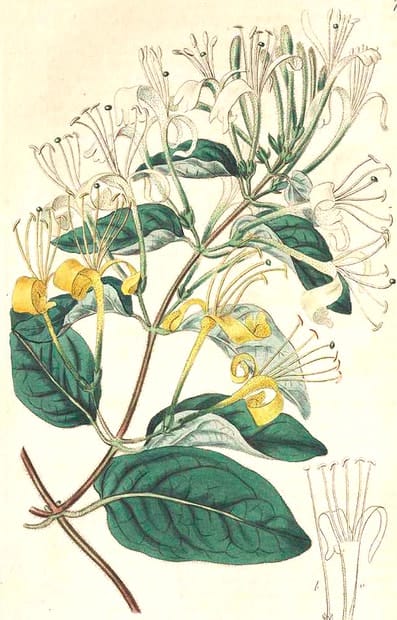
Botanical Register, 1815
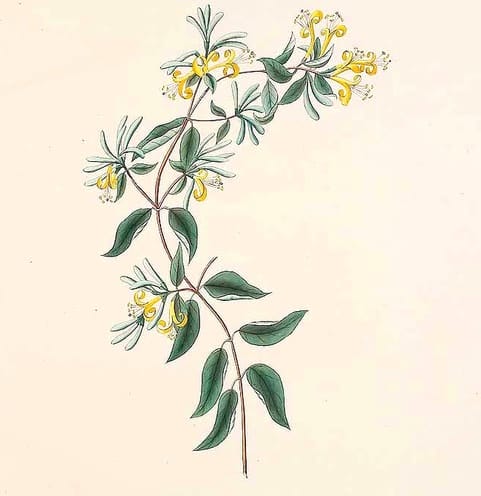
Kerner, Hortus Sempervirens, vol. 60: 1825
Botanical name:
Lonicera japonica
Parts used:
Stem, collected Autumn and Winter
Temperature & Taste:
Cold, dry. Bitter
Classification:
Uses:
1. Clears Heat and Toxin:
-Epidemic and Infectious diseases
-Acute Dysentery
-Strangury, Dysuria, Hematuria from Damp-Heat Toxin
-Carbuncles, Boils, Sores
2. Clears Wind-Heat from the Channels:
-acute heat-type Arthritis with red and swollen Joints
-Stroke from obstruction of the Meridians
Dose:
Decoction: 9–30 grams
Substitutes:
In most cases, Lonicera Flos Jin Yin Hua can replace Lonicera Caulis Ren Dong Teng. “The stem, leaf and flower all have the same therapeutic functions” (Li Shi Zhen)
Main Combinations:
1. Boils, Sores, Carbuncles:
i. Lonicera Caulis Ren Dong Teng with Dandelion (Pu Gong Ying)
ii. Lonicera Caulis Ren Dong Teng with Rhubarb (Da Huang), Coptis Huang Lian
2. Strangury, Dysuria, Hematuria, Lonicera Caulis Ren Dong Teng with Plantain Seed (Che Qian Zi)
3. Post Stroke, Lonicera Caulis Ren Dong Teng with Dang Gui, Ligusticum Chuan Xiong, Safflower (Hong Hua), Peach kernel (Tao Ren), Scorpion (Quan Xie) (as in Zhong Feng Hui Chun Pian)
Cautions:
Not used in cold and weakness of the digestion.
This is the less commonly used stem of Honeysuckle. The flower (Jin Yin Hua) is far more commonly used..