Mithridate & Theriac
The Noble Medicines Against all Poison & Infection
By Adam Tate (2017)
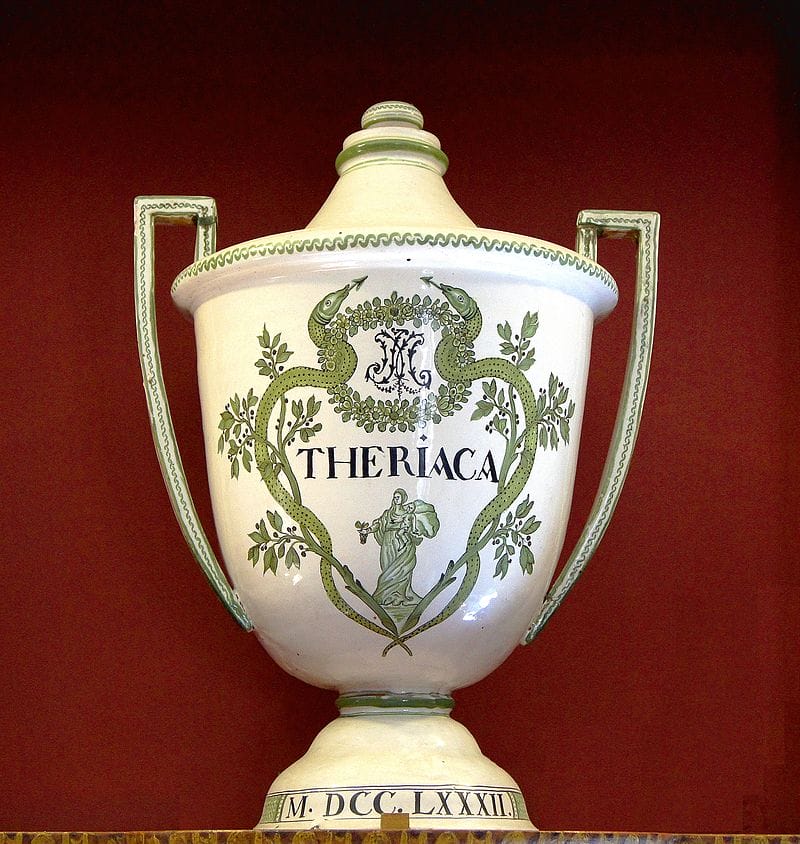
Theriac pot dated 1782 from the Hospices de Beaune
(Image by jebulon in Public Domain)
There were two great and noble compounds used throughout Europe since ancient times. These were Mithridate and Theriac.
The former, named after Mithridate (132-63 BC), King of Pontos, was first made to protect the King from all poison. So paranoid of poisoning was the King that it is said he tested poisons against condemned prisoners before giving them traditional antidote simples. Those that proved their efficacy against a certain poison were combined into Mithridate’s grand formula.
Mithridate was a ‘most generous and most learned Monarch, who understanding the languages of 22 Nations, and having much skill in Medicine, made this noble Antidote against Poison, whereof he was most afraid: by the use whereof, he lived long free from all virulency and deletery qualities’.
After his death, a manuscript of medical commentaries was found. A certain Pompey took these to Rome, giving them to the Roman Physicians Damacrates and Andromachus, who both approved of all the remedies listed, but were especially intrigued by his Mithridate. Damacrates rendered the formula into Latin verse in an effort for it not to be modified from its original
The latter, Theriac, which became known as Treacle in England, was originally designed by Andromachus the Elder, physician to Nero, but was later modified by Galen, where it was to become a standard medicine for nearly two millennia. During the 16th-18th centuries, the best was that made in Venice, hence its alternate name, Venice Treacle.
In Venice and other Italian and European cities, the towns best physicians, along with noblemen and even royalty would attend, and an elaborate ceremony was performed during which Theriac was made. All the medicines to be used were put out on display to ensure the quality and certainty of the ingredients. Then, with elaborate ritual and reverence, the medicine was formulated according to the traditional method. This was partly to ensure the quality and also as a way of promoting the product against rival cities.
Both these medicines were designed and used primarily against all Poison–both vegetable and mineral poisons, as well as Contagious and Epidemic diseases including the Plague; in fact, for almost 2 millennia, these were the staple medicines used in such conditions. They were also used for a wide variety of other disorders, for which they were often added to other compounds or taken with certain vehicles.
Theriac had many versions made in various European towns. Later, the Pharmacopeias of London, France and others would rewrite their own version which was usually greatly simplified and relieved of its unobtainable ingredients.
Because they were much sought after, and relatively expensive, they were often counterfeited. Ibn Ridwan in his Useful Book (12th c?) relays the story of one who supposedly prepared the Theriac of Andromachus, and wished to prove its efficacy. He ordered two cocks to be bitten in the same place by a snake, administered his remedy to one and not the other. Apparently the cock that took the medicine died, while the other cock lived.
Mithridate, Treacle of Andromachus, Philonium and Diascordium formed ‘The Four Capitals’ being the cornerstones of medicine, particularly in the treatment of Epidemic and Infectious diseases.
Antidotus Mithridatium Damocratis
Damocrate’s Mithridate
a. A version out of Galen:
Myrrh 16 oz.
Cinnamon 15½ oz.
Ginger
Spikenard
Thlaspi seed
Saffron
Troches of Agaric
Frankincense 15 oz. ea.
Schoenanth 13 oz.
Laurus cassia
French Lavender
Seseli seed
Long Pepper
Costus
Castoreum 12 oz. ea.
Pennyroyal
Scordium
Carrot seed
Balsam fruit
White Pepper
Cassia Wood
Bdellium 1½ oz. ea.
Gentian
Dittany of Crete
Red Lavender
Rose
Celtic Spikenard
Parsley seed
Fennel seed
Lesser Cardamon
Gum Arabic 7½ oz. ea.
Calamus 5 oz., 3 drams
Round Birthwort
Valerian
Aniseed 4½ oz. ea.
Ligusticum meum 3 oz., 6 drams
St. John’s Wort tops
Skink 3½ oz. ea.
Juniper berries 1 oz.
Powder them all, mix, and sift; then, in 8 lbs. of Wine dissolve 12 oz. of each of Galbanum, Opopanax, and juice of Hypocist, 4½ oz. of Sagapenum, Opium 7½ oz., and of Juice of Acacia, 4 oz. Mix this solution into 106 lbs. of clarified Honey, then slowly mix in the powder, stirring it in well. Next add 12 oz. of Storax dissolved in 14 oz. of Turpentine, and lastly add 12 oz. of Opobalsamum. Stir for several hours, then leave the mixture to ferment in a large vessel. As with the Theriac of Andromachus, it was to be left for at least several months, stirring it weekly or so.
b. A Reformed French version out of Renodeus:\
Myrrh
Saffron
Agaric
Ginger
Cinnamon
Indian Spikenard
Frankincense
Treacle Mustard seed 10 drams ea.
Hartwort
Opobalsamum
Schoenanth
Arabian Stoechas
Costus
Galbanum
Turpentine
Long Pepper
Castoreum
Juice of Cistus
Storax Calamita
Opopanax
Indian Leaf 1 oz. ea.
Cassia wood
Mountain Poley
White Pepper
Scordium
Cretian Carrot seed
Cubebs
Troches of Cypheos
Bdellium 7 drams ea.
Celtic Spikenard
Gum Arabic
Macedonian Stone Parsley
Opium
Lesser Cardamon
Fennel seed
Gentian root
Red Roses
Cretian Dittany 5 drams ea.
Annis
Calamus
Orris
Arum (or Round Birthwort)
Valerian
Sagapen 6 drams ea.
Cyprian Spignel
Acacia
belly and loins of skinks
St. John’s wort tops 2½ drams ea.
Best Clarified Honey 9 lbs., 8 oz.
Best Wine 1 lb.
The gums and juices are infused in a little wine, except Gum Arabic and Olibanum, which are powdered and added to the rest; next the roots are beaten in a large mortar and pestle, gradually adding the herbs, and beating well. The gums are then gently heated until the wine has gone, then the gums and powder are well mixed, and put through a sieve, then mixed with the clarified Honey. After it is thoroughly mixed, it is put into a fit vessel (so that it is only two-thirds full). For the first month it is agitated (mixed) daily; in the second month, twice weekly; in the third month, once weekly; in the fourth month, three times, then left until the sixth month, where it is again stirred well. In this time it will rise to fill the vessel.
Mithridate was taken for all types of acute diseases, and was used in numerous different manners, both internally and externally. It was principalle used to avert and treat Epidemic and Infectious diseases
Uses of Mithridate from Wirtzung (1598):
1. To strengthen the stomach after purging in Heat of the Head with Melancholy (with Bugloss conserve)
2. In an external wash for head wounds (with Theriac, Egyptian Ungent, Aqua Vitae and Carduus water)
3. Taken to beautify the Face (not in young, hot people)
4. Pain of the Eyelids (applied topically to the eyelids and held in the mouth)
5. ‘a special property to put away the clouds, and all that swarm before the eyes’.
6. Cancer of the Nose: ‘chiefly Treacle and Mithridate thrust into the nostrils, and to hold the same in the mouth and eat it’.
7. Good for Tinnitus and loss of hearing, taken after purging with conserve of Bugloss
8. Improves Memory, taken after purging
9. Vertigo: ‘Treacle and Mithridate are also much commended for this purpose’.
10. For Dead Palsy
11. Epilepsy, after purgation, taken with Balm water.
12. Swelling and Falling down of the palate [of the mouth] through Cold’.
13. Loss of Speech (as a gargle in water of Sage, Marjoram and/or Rosemary)
14. Toothache, internally and topically
15. Sore Throat from Phlegm (no heat signs)
16. Cold and Moist Cough (after purging)
17. Asthma
18. ‘Treacle and Mithridate do marvelously withstand the spitting of Blood, if there be taken of them one dram and a half, tempered with Vinegar and Purslane water’.
19. Phthisis and Consumption
20. ‘Fainting of the Heart’; Heart weakness
21. Palpitation
22. Hernia through Wind: ‘the patient every morning [is] to take seven hours before meat one dram of Mithridate with two ounces of the water of Rue. This is a divine medicine to expel wind, and to take away the occasions thereof’.
23. To increase Semen
24. Dysentery (not heat-type)
25. Stomach Pain (taken in wine)
26. Liver obstruction through Cold, ‘very commodious’.
27. One-1 ½ drams taken with wine potently provokes sweat in Edema
28. To cleanse the Blood of Melancholy
29. Kills Worms
30. Gravel and Stones, taken with Decoction of Chickpeas
31. Excessive Urination from Cold, ½–1 dram, taken with wine
32. Gently promotes Menstruation
33. Arthritis, take 1 dram twice a week, or alternate with confected Chebula
34. Small Pox
35. Swelling of the Veins, applied topically
36. To promote sweat
37. Tightness of the Sinews
38. Clear Phlegm
39. Plague, Epidemic and Infectious diseases
40. People caring for Plague victims were to take Mithridate daily to avoid infection.
Dose: typically, 1 scruple to 1 dram.
Theriaca Andromachi Senioris
or, Theriaca Venezian
Treacle of Andromachus the Elder, or, Venice Theriac
a. The first version out of Galen:
Troches of Squill 48 oz.
Troches of Viper
Calamus
Long Pepper
Opium 24 oz. ea.
Florentine Orris
Licorice
Scordium herb
Roses
Cinnamon
Rape seed
Agaric
Opobalsamum 12 oz. ea.
Arabian Costus
Pontic Rhubarb
Cinquefoil
Schoenanth
Horehound
Dittany of Crete
Calamint
Lavender
Saffron
Cassia Wood
Spikenard
Ginger
Black Pepper
Macedonian Parsley seed
Olibanum
Myrrh
Turpentine 6 oz. ea.
Ligusticum meum
Rhubarb
Gentian
Pennyroyal
Ground Pine
Germander
Laurus cassia leaf
St. John’s Wort flowers
Balsam fruit
Celtic Spikenard
Cardamon
seeds of Annis
Fennel
Cress
Seseli
Thlaspi
Amomum
Sandwort
Storax
Gum Arabic
Sagapenum
Acacia juice
Hypocistis
Lemnian Earth
Calcined Green Vitriol 4 oz. ea.
Birthwort
Lesser Centaury
Carrot seed
Bitumen
Opopanax
Galbanum
Castoreum 2 oz. ea.
b. Reformed version (London Pharmacopoeia, 1746)
Troches of Squills 3 oz.
Long Pepper
Opium
Dried Vipers ½ lb.
Cinnamon
Balm of Gilead 2 oz.
Agaric
Orris root
Scordium
Roses
Navew seed
Licorice juice 1½ oz.
Spikenard
Saffron
Greater Cardamon
Myrrh
Costus
Camel’s Hay 1 oz. ea.
Cinquefoil root
Rhubarb
Ginger
Indian leaf
Cretian Dittany leaf
Horehound
Calamint
French Lavender
Black Pepper
Parsley seed
Frankincense
Chio Turpentine
Valerian 6 drams
Gentian
Celtic Spikenard
Spignel
Poley Montane
St. John’s wort
Ground Pine
Creeping Germander
Balsam fruit
Aniseed
Fennel seed
Lesser Cardamon
Bishops weed
Hartwort
Treacle Mustard
Juice of Rape
Juice of Cistus
Catechu
Gum Arabic
Storax
Sagapen
Earth of Lemnos
calcined Green Vitriol ½ oz.
Creeping Birthwort
Lesser Centaury
Cretian Carrot seed
Opopanax
Galbanum
Castoreum
Judean Pitch
Calamus 2 drams
Clarified Honey, 3 times the weight of the rest
Generally speaking, all the dry ingredients may be powdered together, beginning with the hardest substances, gradually adding the softer ones. The Gums are dissolved together in wine, the Castor and Saffron should be powdered separately, and the Bitumen, Earth and Chalcite can be pulverised together, all these being added towards the end. Either the Troches or Powders of Squill and Vipers can be added to the rest, all being powdered, then added bit by bit to the warmed Honey, adding the Saffron and Castor at the end.
When it is quite cool, it is placed into an earthen vessel which must remain at least one-third empty to allow for the rising which occurs during fermentation which may be quickened by leaving in a warm place. It should be stirred with a wooden spoon twice a week, for around 15 minutes each time for the first 2 months, then once a week for another 4 months, making 6 months in total, which was said to be the minimum required time for the full fermentation to take place.
Originally, the Honey was mixed with sufficient wine, and they were both boiled together to clarify the Honey. But this leads to a lessening of the positive qualities of the Honey due to the more volatile parts flying away with the alcohol. Therefore, the Honey can be clarified by being very gently heated without addition, removing the scum as it arises.
As with Mithridate, Theriac was used for various conditions, mostly of an acute nature, and especially in the prevention and treatment of Epidemic and Infectious diseases. It may be used for acute Fever, all types of Poison, Cough, Asthma, Pneumonia, etc.
Suggested Vehicles for Taking Theriac:
i. for Poisons, take with warm wine.
ii. for Asthma, take with Decoction of Wood Sage
iii. diseases of the Lungs and Chest, and Spitting Blood, take with Barley water.
iv. chronic diseases, take with Decoction of Hyssop.
v. Jaundice, take with decoction of Asarum.
vi. for Edema, take with Oxymel.
vii. Peri-pneumonia, take with decoction of White Horehound.
viii. Colic and Intestinal diseases, take with decoction of Celery.
ix. For Wounds of the Intestines, take with Decoction of Sumac.
x. Taken with water of Radish roots, or water of Pellitory of the Wall, or Decoction of Celery for Kidney diseases and to break Stones.
xi. Periodic Fever, and many other diseases, take with warm water.
xii. Paralysis, with Sage
xiii. Epilepsy with decoction of Peony
xiv. Mixed with wine and applied to cold type Toothache
xv. Congealed Blood in the Chest, take with decoction of Licorice and Maidenhair
xvi. Phthisis or Lung ulcer, take with decoction of Figs
Dose: children may take 1–3, or 4, and up to 6 grains, depending on age and severity of the disease; Adults may take 1 scruple to 1 dram, and up to 2 drams for strong constitutions, or in urgent cases. It was typically taken in a dose the size of a Hazelnut.
Reformed Versions of Theriac
Over the centuries, various reformations were made of these classic and complex formula. Numerous substitutions and alterations were made but the most significant changes were in the drastic simplifications that occurred in the 18th and 19th centuries. Various authors and Pharmacopoeias published greatly simplified versions, intended to have the same effect. From a practical viewpoint, and especially if they were wanted to be recreated, these are most relevant
They also serve to show a basis from which other medicines from the original formulas could be added.
Reformed Theriac of the Swedish Pharmacopeia
The Swedish Pharmacopoeia of 1775 reduced Theriac from over 60 ingredients to just nine:
Angelica 300 grams
Gentian 200 grams
Valerian 90 grams
Zedoary
Cardamon
Myrrh
Saffron
Opium 30 grams ea.
(Doses are rounded off)
‘Official Theriac’
Elecampane 2 oz.
Zedoary
Myrrh
Round Birthwort.
Angelica. 1½ oz.
Rob of Juniper 6 oz.
Clarified Honey
Syrup of Poppies. 8 oz.
Mix. Dose: 1 dram–½ oz.
(Dispensarium Lippiacum, 1792)
‘Common Theriac’
Elecampane 15 drams
Round Birthwort 10 drams
Juniper berries
Zedoary
Water Germander
Germander
Ground Pine 5 drams ea.
Long Birthwort
St. John’s wort
Scabious
Rue seed
Savin 3 drams each
Betony
Sage
Horehound
Roman Spikenard
Bay berries
Gentian
White Dittany
Tormentil
Calamus 2 drams each
Spignel root
Valerian
Saxifrage root
Seeds of Bishop’s weed
Caraway
Mace
Red Sandalwood
Lemon Balm
Red Mint
Yellow Amber 1 dram each
Wormwood
Calamint
Ginger
Black Pepper
Castoreum 1⁄2 dram each
Walnuts 10
Oil of Turpentine 1 oz.
Oxymel of Squill 4 oz.
With three its weight of clarified Honey, form a Theriac according to Art. Dose and use is as for Theriac. This was prepared as a more practical and affordable Theriac. It first appeared in Pharmacopoeia Augustana.