
Pill Millipede, Shu Fu 鼠妇
Wood Lice, Wood Louse, Hog Lice, Sow Lice, Pill bug, Slater
Shu Fu (TCM)

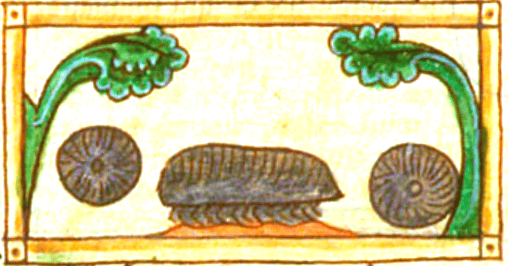
Pill Millipedes (Manuscript 13th C., British Library, Harley 3244)
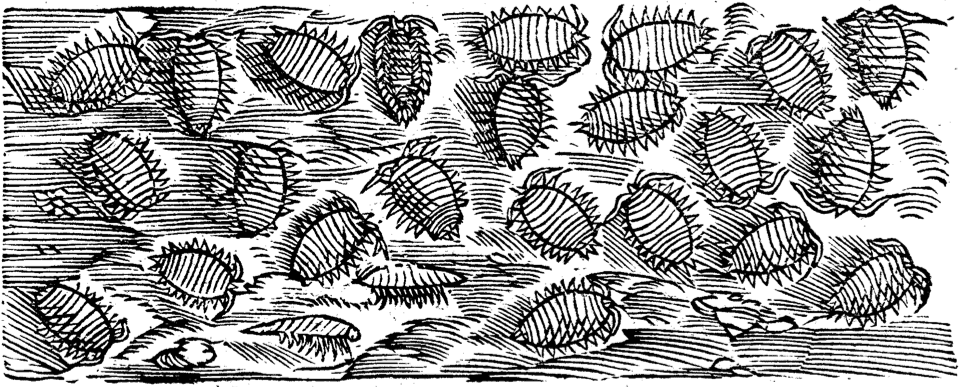
Pill Millipede
Dioscorides Materia Medica, Mathias, 1563
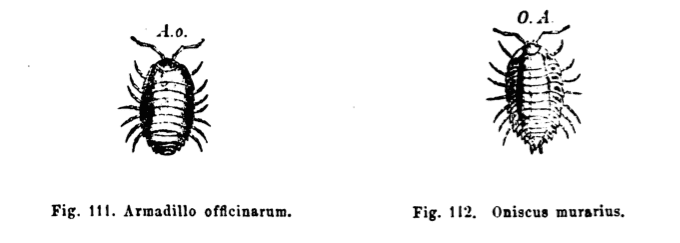
Handbook of Pharmaceutical Practice, Hager, 1878
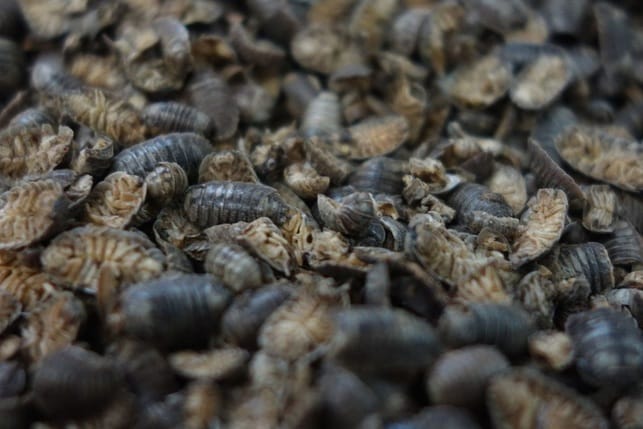
Pill Millipedes (Armadillidium vulgare) (Chengdu Medicine Market, 2015)
Entomological name:
Two distinct but related genus supplied the traditional market:
- Oniscus spp.; O. ascellus was commonly used in Europe, and is listed by some TCM sources. Porcellio scaber is similar (Porcellis spp. is called Shu Fu in TCM)
- Armadillidium vulgare was used in Europe, and is used in TCM. (Ping Jia Chong, TCM)
Differentiation:
- Oniscus ascellus: antenna is inserted beneath the anterior margin of the head, the body is oval and larger than the Armadillo; it is a brown or dirty ash color, and the body cannot roll itself into a ball.
- Armadillidium vulgaris, (syn. A. officinalis) (official): external antenna, body more elongated; the body is lead colored, and it is capable of rolling into a ball. Porcellis spp. is more like this than the former.
Parts used:
Whole dried insect
Temperature & Taste:
Warm (some said Cold), dry. Sour, Pungent, Sweet
Constituents:
Mucopolysaccharides, Chondroitin sulfate
Fatty Acids: tetradecanoic acid, hexadecanoic acid (20%), octadecanoic acid, arachidic acid, octadecenoic acid (53%), octadecadienoic acid (10%), octadecatriene Acid
Enzymes including hyaluronidase, nearaminidase
Sterols, mainly cholesterol
Androgenic hormones have been isolated
Trace elements: sulfur, phosphorus, sodium, calcium, iron, magnesium
Uses:
1. Clears Damp, Promotes Urine: (TCM, West)
-Urinary Obstruction, Edema, difficult urination, Dysuria
-Gravel, Stones (some considered them specific)
-Jaundice.
-also regarded as Aphrodisiac in traditional texts (TCM)
-“Inability to pass Urine”. (Ben Cao Gang Mu)
2. Clears Wind-Heat, Resists Poison: (TCM, West)
-Feverish Chills, Malaria; used for chronic Malaria in both TCM and Europe
-Syphilis
-sore and inflamed Throat and Tonsillitis, it is taken with honey
-Tetanus with Chills and Fever (Ben Cao Gang Mu)
-antidote to some Poisons, such as Arrow Poison and Spider Bites (TCM, Dioscorides)
3. Moves the Blood, Clears Stasis: (TCM, West)
-Amenorrhea, dysmenorrhea’
-Abortifacient (TCM, West)
-Abdominal Cramps, Abdominal Masses, Blood Clots (TCM, West)
-Postoperative Pain (TCM)
-also for Uterine Bleeding
-suppressed eruptions in infectious diseases including Small Pox
4. Moves the Blood, Resolves Masses: (TCM, West)
-commonly used in Europe for all sorts of Toxic Swellings, Scrofula, Poison Tumors and Cancer, especially of the Breast.
-‘From three to twelve were formerly given in Rhenish wine for a hundred days together to cure all kinds of cancers’. (Herbal Simples Approved for Modern Uses of Cure, W.T. Fernie, 1897)
-they have also demonstrated a strong effect in relieving Cancer pain (Chinese research)
-Leprosy (both internally and topically over lesions).
5. Calms Wind, Stops Spasms, Relieves Pain: (TCM, West)
-Epilepsy and Infantile Convulsions, Tetanus, Lockjaw
-Toothache from Wind or Caries; inflamed gums (TCM, West)
-Rheumatism, and all kinds of Muscle and Nerve pain (the Spirit of them was the preferred preparation for these purposes)
6. Stops Cough and Wheezing:
-with honey for Asthma, Coughs including Whooping Cough (Salmon; Arabic physicians)
-Cough, Chronic Bronchitis (TCM)
-Emphysema (when used for 2–3 months, the effects have been very effective in some cases: TCM)
-most effective for Lung and Kidney deficiency type, or cases with Cold
-Pleurisy, etc.
7. Clears Sight, Benefits the Eyes:
-“dimness of sight, yea blindness itself” (Salmon)
-in Weakness of Sight, they were said to be “exceedingly efficacious”. (Medical Zoology, 1861)
8. Externally:
-Boiled in Oil or Goose fat and dropped into the ear for earache and deafness.
-Toothache, a fresh beaten Pill Millipede is put into the cavity or on the gum
–Stomatitis, Tonsillitis, Thrush, Gingivitis (powder blown directly onto the place)
Dose:
1. Taken with wine to move the Blood and open Obstructions.
Of the powdered Pill Millipede: 500mg–1 gram (up to 2 grams), taken in wine, although some older writers said rarely over 1 Scruple (1.3 grams) because they ‘dissolve too much’.
The powder can be put into capsules, each capsule containing 100mg. 2–4 capsules can be taken as a dose, three times daily..
The Powder has also been pressed into tablets containing 500mg. Dose: is 2–5 tablets (for Chronic Bronchitis etc.)
For visceral obstructions, tumors and Cancer, 30–40 (up to 100) are infused over night to be taken over the course of the following day, treatment being continued for 1–3 months.
A typical dose in old Chinese texts is 7 dried insects, powdered and taken with wine.
Up to 200 insects have been given per day. (Medical Zoology, 1861)
Some Chinese texts said to express the juice from the fresh insect and take that with wine.
Comment:
‘In ancient prescription, the Pill Bug was used very often in treating convulsions, malaria, and blood disorders, as it is a drug functioning on the Greater Yin Channel’. (Li Shi Zhen, Ben Cao Gang Mu, TCM)
Preparations:
1. Steamed with alcohol to kill them; this also makes them better to move the Blood.
2. Sprinkle with Brandy, then dry. This can be repeated twice.
3. They can be stir-fried until lightly yellowed.
4. Some practitioners burnt them until scorched, or even into ashes, then powdered them.
Substitutes:
1. Salmon said of Wasps: ‘Some use them in all cases where Sows or Hogs Lice are used, and with the same success’.
2. They are similarly used to Wingless Cockroach (Tu Bie Chong) of TCM.
Main Combinations:
Lungs:
1. Whooping Cough:
i. Pill Millipedes with Aniseed and Nutmeg
ii. Pill Millipedes with Asparagus root, Licorice, Borage, Raisins (Formulaire Magistral et Memorial Pharmaceutique, 1823)
iii. Pill Millipedes with Ginger, Licorice, Ipecac, made into a tincture with 20% alcohol, then form into a syrup with sugar (Hager’s)
2. Chronic Cough, Pill Millipedes with Nettle seed, Burdock seed, Nutmeg
3. Asthma:
i. Pill Millipedes with Garlic
ii. Pill Millipedes with Hyssop
iii. Pill Millipedes with Flowers of Benzoin, Elecampane and Saffron
iv. ‘Throw two measures of the insects that collect under the water jars and are called “millepedes” into a potter’s vessel, heat them over the fire, and when they are white [ashes] rub them down and mix the powder with boiled honey, and administer in the form of a linctus one spoonful fasting.’ (Syrian “Book of Medicine“, trans. by Wallis Budge, 1913)
Nerves
4. Convulsions, Pill Millipedes with Clove
5. Paralysis, Arthritis, Convulsions, Nervous diseases, Cinnabar with Amber with Peony, Mistletoe, Pearl, Millipede, Earthworms, Viper powder (Pulvis Visceralis, Dispensatory of Prague)
Urinary
6. Edema:
i. Pill Millipededs with Bees as a tincture
ii. Pill Millipedes with roots of Fennel, Asparagus, and Golden Rod
7. Edema, Gravel, Stones:
i. Pill Millipedes with Sal Ammoniac, Ivy gum, Juniper
ii. Ants (1 handful), Ant Eggs (200 in number), Millipedes (100 in number), Bees (150 in number), Spirit of Wine (2 lbs.). Infuse 40 days and decant. Also for Impotence, Hysteria and Epilepsy. (Salmon)
8. Urinary obstruction, Dysuria:
i. “Fry seven pill bugs, grind them to powder, and ingest it with wine”. (Ben Cao Gang Mu)
ii. Pill Millipedes with Nutmeg and Clove infused in white wine.
iii. Pill Millipedes with Winter Cherries, Juniper berries (Memorial Pharmaceutique, 1824)
iv. Decoction of Restharrow, Syrup of the Opening Roots, Powder of Pill Millipedes; mix
v. Pill Millipede, Plantain seed (Che Qian Zi), Water Plantain root (Ze Xie) (TCM)
vi. Dysuria: stir-fry 7 Pill Millipedes, grind to powder and take with Wine. (Qian Jin Yi Fang, TCM)
9. Bladder Stones, Pill Millipedes with Viper powder
Scrofula, Tumors, Cancer
10. Scrofula:
i. Burnt Sponge, Pill Millipedes, Potassium nitrate
ii. Pill Millipedes (300), Herb Robert, Mugwort, Celery, Agrimony (4 handfuls each). Infuse in Wine or Ale. Take some every meal for 2–4 weeks. (Hartman, 1682)
iii. Pill Millipedes with Guaiacum, Walnut bark, Dock root, Herb Robert and Raisins (as in Ale Against Scrofula)
11. Fibroid Tumors:
i. Pill Millipedes with Bees
ii. Pill Millipedes, Figwort
iii. Guaiacum with Sassafras, Sarsaparilla, Dead Nettle, Ground Ivy, Herb Robert and Pill Millipedes
12. Cancer:
i. Pill Millipedes (200), bruise and infuse in 1 quart of White Wine. Drink this continually for 40 days. (Salmon)
ii. Sage, Rue (1 handful each), Pill Millipedes (300), small Ale (4 gallons). Bruise the herbs and Millipedes, put in a sack and infuse in the Ale (or white wine). A small cupful can be taken 3 times daily, some recommended only drinking this liquor. until cured. “They are excellent, and much recommended for the curing of all sorts of Cancers, and schirrous Tumors in what part of the Body soever, the Kings Evil [Scrofula], all sordid, inveterate and rebellious Ulcers, and old Sores”. (Hartman, 1682)
iii. Cancer and Scrofula, Guaiacum with Sassafras, Sarsaparilla, Dead Nettle, Ground Ivy, Herb Robert and Pill Millipedes
iv. with Guaiacum, Sassafras, Sarsaparilla, Sharp pointed Dock, Filipendula, Walnut bark, Herb Robert, Pill Millipedes (Fuller)
v. Pill Millipedes with Angelica, Burdock root, Elecampane, Gentian, Herb Robert, Sage, Rue (as in Cancer Ale)
vi. Roots of Daisy, Burdock, Guaiacum, Sassafras, Sarsaparilla, China root, Tormentil. Celandine, Yarrow, Plantain, Herb Robert, Agrimony, Speedwell, Ground Ivy, Archangel flowers, Fennel seed, Coriander seed. This was distilled from Milk, adding a spoonful of the juice of Millipedes to each dose. (A Collection of Recipts, ‘By Several Hands’, Fifth Edition, 1734)
Other:
13. Jaundice:
i. Pill Millipedes with Saffron and Celandine
ii. Pill Millipedes with Saffron and Turmeric
14. Amenorrhea, Pill Millipede, Red Peony (Chi Shao Yao), Safflower (Hong Hua), Peach kernel (Tao Ren) (TCM)
15. Rickets, Pill Millipedes with Licorice, Ash bark, Harts Tongue, Raisins
16. Malaria:
i. Pill Millipedes (14), soak in wine dregs then make 14 Pills. Take 7 pills before the malarial chills. (Ben Cao Gang Mu)
ii. with Chills and Fever, beat 4 Pill Millipedes with Sugar, and form pills. Take before a Malarial attack. (Ben Cao Gang Mu)
iii. pound Pill Millipedes (14) with prepared Soy beans (Dou Chi) (14). Beat to a paste and form into pills the size of a Fox nut (Eurayle). Take 2 pills when needed with hot water. (Ben Cao Gang Mu)
17. Lockjaw: pound fresh Pill Millipedes, extract a little juice and give it. (Tai Ping Sheng Hui Fang, TCM)
18. To improve eyesight, form an Infusion of Pill Millipedes with Rue, Sage, Vervain, Eyebright, Fennel seed and Raisins
Externally:
19. Stomatitis, Tonsillitis, Thrush, Gingivitis:
i. Grind Pill Millipedes with water to a paste and apply topically. (Shou Yu Fang, TCM)
ii. Powder, mix with a little Borneo Camphor and apply topically or blow onto the throat. (TCM)
20. Toothache from Wind:
i. wrap a Pill Millipede in silk cloth and bite between the teeth. (Tai Ping Sheng Hui Fang, TCM)
ii. Pill Millipede (1), Croton seed (1 grain), Black Pepper (1 grain), powder, mix and form pills the size of Mung bean. Wrap in silk and apply topically. ‘This works very effectively’. (Jing Xiao Ji Shi Fang, TCM)
21. Pain, Pill Millipede, Corydalis Yan Hu Suo, Cynanchum Xu Chang Qing. This has been developed into a gel for topical use for pain and has also been formed into pills for internal use.
Major Formulas:
Tincture of Pill Millipedes
Powder for Cancer
Cautions:
1. They are very opening and dissolve strongly. Avoid overdose.
2. Not used during Pregnancy. “They cause miscarriage”. (Ben Cao Gang Mu)
3. Not suitable for marked Qi or Yin deficiency.
4. Pill Millipedes bioaccumulate heavy metals in contaminated soils.
5. Some related species, especially in the tropics, are poisonous.
Main Preparations used:
Infusion; Conserve; Tincture; Volatile Salts; Spirit
1. Conserve of Pill Millipedes:
i. living Pill Millipedes (1 pound), White Sugar (2 ½ lbs.). Triturate. Dose: 1–2 drams. (Dispensarium Lippiacum, 1792)
ii. Pill Millipedes (25 parts), Sugar (75 parts). Beat together. (Hager’s)
2. Infusion of Pill Millipedes:
i. Fresh Pill Millipedes, bruised (6 drams), Water (3 oz.), Alcohol (1 oz.). Macerate an hour and express strongly. (Pharmacopoeia Sardoa, 1773)
3. Tincture of Pill Millipedes:
i. Dried Pill Millipedes (½ oz.), Rectified Spirit (6 oz.). Digest, express, filter. (Dispensatorium Pharmaceuticum, 1777)
ii. Dried Pill Millipedes (1 oz.), Spirit (1.5 liters). Dose: 10–30 drops.
iii. Dried Pill Millipedes (1 part), Diluted Wine Spirit (10 parts).
HOGLOUSE, or PILL MILLIPEDE.
The Hoglouse (Common Armadillo), is very well known throughout Europe, and has long been employed as a populär medicine. It is technically called Glomeris marginata, being found as a familiar object under old wood and dry stones in almost every country garden, and certainly in every field, throughout the greater part of England.
When touched it rolls itself up into a ball, and frequently remains in the same state for a considerable time. This Hoglouse, or Millipede, was the primitive medicinal pill. It must not be confounded, as is often done, especially by the former writers, with the Woodlouse (quod vide); a similar insect which inhabits rotten wood and old walls, being somewhat larger than the Hoglouse, but the body whereof does not contract itself into a ball, whilst its tail is seen to be furnished with two prominent lateral styles. By these characters it may be readily distinguished. Millipedes abound with a nitrous salt which bas made them of much reputed use for curing scrofulous diseases, and inveterate Struma, as also for some kinds of stone in the bladder. The London College of Physicians in early days directed that thesc creatures sbould he dried, and suspended in a thin canvas bag placed within a covered vessel over the steam of bot spirit of wine, so that being killed by the spirit they might become friable. They were prescribed both fresh and dry in obstruetions of the liver, and of the digestive organs, as well as for the other conditions just named. Dr. Salmon (1696) said : “They dissolve the stone in both reins and bladder ; they open obstructions, and cure the jaundice, help the cholic and asthma, restore the appetite, and are most admirable things.” Dr. Quincy wrote (1730), “They abound with a nitrous salt which they seem to derive from what they live on; they are good in palsies, and all nervous distempers: likewise because of their asperities they cut their way through any obstructions they are good in struma, scrophulous tumors, and inveterate ulcers, being much best taken in substance, or bruised in white wine, the liquor being swallowed without settling fine, else a great deal of the saline matter will fall to the bottom.” Nevertheless Dr. Willis (1662), who tried to reform the ignorant, and merely empirical medicine of his day, pronounced,” It is a vulgär, and ill-considered remedy for our countrymen to take (for the jaundice) nine hoglice alive in the morning for five or six days together: by doing which I have heard that many have been cured when other things did no good; and these certainly can give relief in no other way than by restoring the volatile salt which had become depressed in the blood.
Millipedes have a faint disagreeable smcll, and a somewhat pungent sweetish taste. On analysis they afford an alkalescent fluid, and an oil seemingly inert. Given in modern days by Dr. Lewis they have been found considerably active; whilst Dr. Cullen teils us he has known a hundred of the little creatures taken twice a day without producing any sensible action. Perhaps the difference of experience may have been partly due to a confusion between the kinds of insects administered, whether the millipede, or its Simulator, the woodlouse.
In Scotland the Porcellio Scaber (allied to the Hoglouse,) which is called there” Sclater,” has been for some while in rustic medicinal vogue. Varioua names are commonly given in this country to the millipede, such as Thrush louse, Tiggyhog, Cheslip, Kitchenball, Chiselbob, Lugdor, and Palmer, also Cudworm, because it is sometimes put down the throat of a Cow, like a pill to promote the restoration of her Cud.
In the Eastern counties it is known as Old Sow, or Saint Anthony’s Hog; whilst the Welsh call the small creature Grammar Sow, the little old Woman of the wood, and the little Grey Hog; their word “gurach,” like grammar, or gammar, meaning a dried up old dame. Millipedes may be still found among the obsolete stock of some druggists’ shops, being supposed by those who notice them to have been used in former medicine more on account of their resemblance in shape to pills than because of any inherent curative virtues, or properties they could boast. In reality their earth salts and characteristic oil must be the remedial principles which they actually possess.
These creatures, as Dr. Salmon put it, are so much in the acquaintance of the common people that folk seem to be masters of their medicinal virtues, and use them in many cases without any other direction: the Hoglice are by all experience very diuretick, and abstersive, not only for disorders of the reins, but also in obstructions of the viscera, and in the jaundice particularly. Dioscorides wrote : “The loops, or the worm with many feet, drunk in wine cureth the jaundice: these loops lightly bruised, and bound in a thinner piece of linen, adding thereto wine, and being pressed, are given thereof to the sicke (of jaundice,) in the morning as he lieth in his bedde, and for some daies together; and for the taste’s sake a little cinnamon and Sugar may be added.’.
In A Thousand Notable Things (1815), we read, as “a perfect sure proved remedy, and a rare secret for helping of women’s breasts that are swol’n, and full of pain,” “stamp or bruise nine little worms, of some called swine lice (which commonly would be found between the bark and the wood of old dry trees, and which have many feet, and being touched become round as a button), in eight or nine spoonfuls of drink; let them remain therein all night, and the eighth morning strain the same drink: and let the diseased woman drink the same a little warm at one draught, and then let her lay on her breast a two or threefold linen cloth warmed; the next morning let her take eight of the same little worms in drink in such order as before; and the third morning seven, and the fourth morning six, and so every morning following one less, until nine mornings be ended, on which ninth morning she must take but one of them, as it. will fall out by decreasing one every day; and if she be not then thoroughly whole of her breast, let her increase every morning one immediately following until she hath received nine at one time, according to the order before appointed.
Again, in 1695, the Hon. Richard Boyle in his Collectüm of Medicines, directed as “a choice external remedy for sore throats, to take mellepedes, sows, or hoglice alive, and sew them up between the foldings of a piece of linnen, and apply them to the throat in the form of a stay, which is to be kept on all night,” Small beds of lemon thyme {Thymus Citriodorus) are cultivated at Penzance in which to rear millipedes or hoglice, for administration as pills in scrofulous disease of various forms. From three to twelve were formerly given, either whole, or in Rhenish wine for a hundred days togetber to cure all kinds of Cancer.
Swamerdam relates an amusing mistake of a servant maid who, finding in the garden a good many millipedes rolled up, thought she had discovered some choice materials for a necklace, and betook herseif to string them with much care; but on suddenly seeing them unroll themselves she was terrified, and ran screaming into the house.
In The Pharmacopoeia of London (1696), all the wonderful qualities then supposed to be inherent in hoglice, or millipedes, were summed up thus : they dissolve the stone in both reins and bladder to a slime, and bring it away; they open obstruetiona, cure the jaundice, all obstructions of the urine, help the cholick and asthma, restore lost appetite, and are most excellent things, being given for a hundred days together, or more, for the curing of all sorts of Cancers and scirrhous tumours in what part of the body soever, the king’s evil, old sordid and rebellious ulcers, convulsions, the rickets in children, and dimness of sight, yea blindness itself; outwardly the powder of them is good against diseases of the eyes and ears, and the quinsy, being mixt with honey, and applied.
“I can personally vouch,” says a present practitioner of medicine, “for undeniable success in treating cases of obstinate catarrhal jaundice by pills made entirely from the pounded bodies of these smal] creatures freshly killed, when the ordinary treatment by hot stupes, aiterative medicines, and gentle mercurials had signally failed.” In France Dr. de Haen has recorded that in certain forms of impaired vision the patients have taken hoglice on bread as a remedy, and that without doubt the odd medicine proved efficacious.
M. Adanson “a vu des etudiants en medicine en croquer quelques douzaines dans ses herborisations ä In campagne, et s’en trouver tres bien.”
Dr. Quincy (1728) directs for “A Simple Expression of Millipedes: Take live Millipedes, and white sugar, of each three ounces: beat them well together in a marble Mortar, and pour upon them one pound of white wine, which strain out again by hard squeezing”:—
” Laudatur vinum simplex : oerevisia duplex :
Est liona duplicitas: optima Simplicitas.”
” Wine which is Simply pure we praise: but Double Stout,
Iike double dealings, we regard with doubt.”
Dr. Füller declared that” too much cannot be well said in commendation of Millipedes; and that the above way of managing them does most surely retain their füll virtues. It may be given for some time together, about three ounces every morning.”” But they seem not convenient for a hot thin blood; and ’tis reported that taken in large quantities overnight they will cause a scalding of urine.” Instances are quoted of wonders performed by them for inveterate strumas, and ulcers.” (Animal Simples approved for modern Uses of Cure, Fernie, 1899)
GENERAL / REVIEW:
–The presence of mucopolysaccharides in the hepatopancreas of the isopod, Armadillidium vulgare.
–Study on differentiation and extract determination of Porcellio scaber and Armadillidium vulgare.
ANTIBACTERIAL
–Armadillidin H, a Glycine-Rich Peptide from the Terrestrial Crustacean Armadillidium vulgare, Displays an Unexpected Wide Antimicrobial Spectrum with Membranolytic Activity
ANTI-INFLAMMATORY:
–Evaluation of antinociceptive and anti-inflammatory effects of aqueous extract of Armadillidium vulgare Latreille
–Development and evaluation of a Chinese herbal gel for analgesic and anti-inflammatory effects.
ANALGESIC:
–Development and evaluation of a Chinese herbal gel for analgesic and anti-inflammatory effects.
BRONCHITIS / ASTHMA
–The History and Outlook of Animal Drugs Treating Asthma, Chronic Bronchitis, and Haze Episode-induced Respiratory Disease, International Journal of Biotechnology for Wellness Industries, 2014, 3, 69-78 69ISSN: 1927-3037/14 © 2014 Lifescience Global
–Anti-asthmatic: effect takes 2 to 4 hours and lasts 4 to 6 hours
–Treatment of Chronic Bronchitis was effective in 81% of cases. (TCM)
NEUROPROTECTIVE (FUNGII ISOLATED FROM):
–Acautalides A-C, Neuroprotective Diels-Alder Adducts from Solid-State Cultivated Acaulium sp. H-JQSF.
ANDROGENIC:
–Partial purification and characterization of androgenic gland hormone from the isopod crustacean, Armadillidium vulgare.
–Synthetic Study of Androgenic Gland Hormone from Armadillidium Vulgare.
–Present state of knowledge on the chemical nature of the androgenic hormone in higher crustaceans
–Purification and Properties of Androgenic Gland Hormone from the Terrestrial Isopod Armadillidium vulgare
CANCER (FUNGII ISOLATED FROM):
–Nine new cytochalasan alkaloids from Chaetomium globosum TW1-1 (Ascomycota, Sordariales).
–Armochaetoglobins A-J: Cytochalasan Alkaloids from Chaetomium globosum TW1-1, a Fungus Derived from the Terrestrial Arthropod Armadillidium vulgare.
“A certain Emperick did help many Cancers in divers People, after this manner. He Stamped Woodlice, and strained them into Ale, and gave the Patient to drink thereof Morning and Evening. This Medicine caused many times a certain black Worm to come forth, which had many Legs, and was quick, and after that the Cancer would heal quickly, with any convenient Medicine” (Collectanea medica, Salmon, 1703)