Pilulae Pestilentiales,
or Pilulae Commune,
or Pilulae Ruffi
Tiryaq Wabai, Tiryaq-e-Afai, or Habb-e-Taaun (Unani)
Pestilential Pills,
or Common Pills,
or Pills of Ruffus

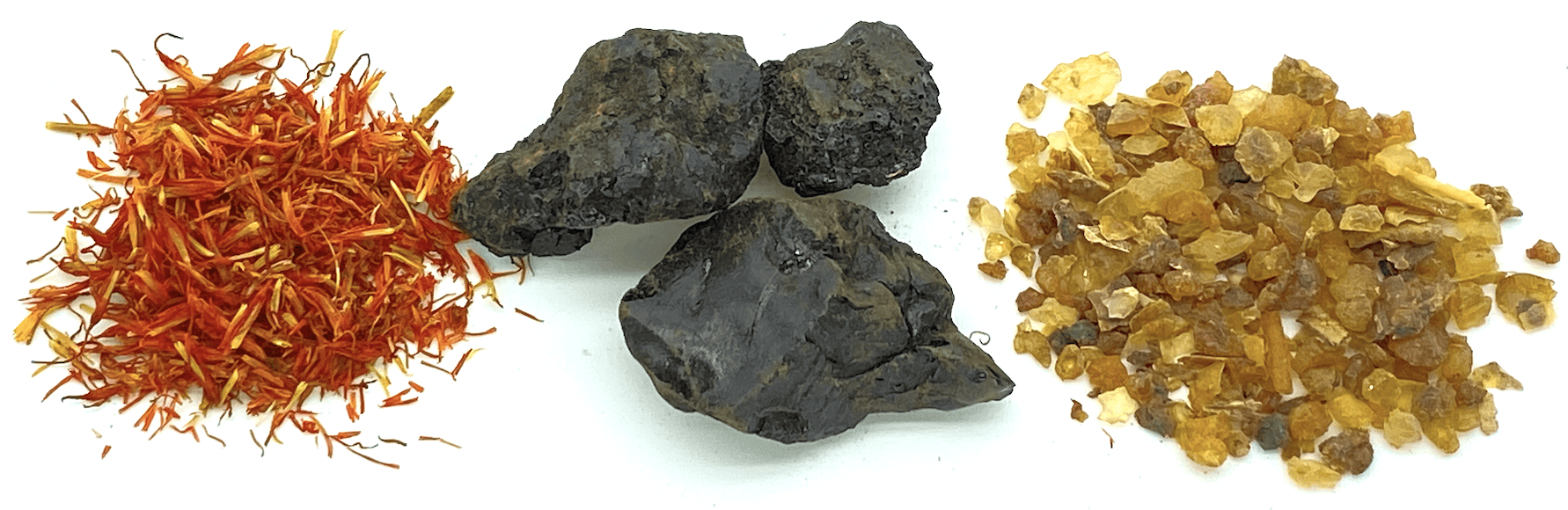
Safflower (Saffron substitute), Aloe & Myrrh
Tradition:
Western, Unani
Source / Author:
Ruffus of Ephesos (98-117? AD)
|
Herb Name |
Latin |
Amount |
|---|---|---|
|
Aloe vera |
2 ounces |
|
|
Commiphora molmol |
1 ounce |
|
|
Crocus sativus |
1⁄2 ounce |
Preparation:
Powder and form Pills the size of peas using Lemon juice Syrup, or Syrup of Wormwood
Function:
Cleanses excess, opens Obstructions, preserves from Infection
Use:
1. Primarily used as a preservative during Epidemics, notably the Plague.
2. Also used in the Infection of Plague and Epidemic diseases, including Influenza and COVID
3. cleanses the Stomach and Bowels
4. promotes appetite and Digestion
5. promotes Menstruation
6. benefit the Lungs.
7. Worms: “Pills of Ruffus are excellent to kill them and bring them forth”. (Praxis Medicinae, Bruele, 1639)
Dose:
1–2 pills (1 scruple–1 dram), before dinner, before bed, or first thing in the morning. Taken in the morning or before leaving the house during epidemic, they were said to prevent infection that day.
Occasionally, it is good to take 1 dram before sleep.
Some soaked the pills in wine and gave it that way.
If infection has just begun, take a dose and go to bed, cover up and sweat.
They were often recommended to be taken every day for one month during the Spring. This would then protect from Fevers over the next 12 months, and if a Fever came, it would only be mild
Cautions:
Not used during Pregnancy
Modifications:
There were many additions to this simple formula.
1. Safflower can be substituted for Saffron, using an equal amount to the Myrrh.
2. They are stronger with Camphor added (1 dram). These were regarded as stronger to preserve from the Plague and other Epidemics, and were also regarded as useful in the early stages of infection, whereas the standard formula was generally viewed as useful once someone was infected.
3. Some added Gum Ammoniac. This is then especially effective for Obstruction of the Spleen.
4. In winter, it was common to add Zedoary, Aloeswood or Red Sandalwood (1 dram)
5. In Summer, remove Myrrh, add Red Earth (3 drams), Red Coral (0.5 dram), Camphor (0.5 scruple)
6. When Rhubarb and Zedoary are added they form Pestilential Pills of Basil
7. Rhubarb, Gentian and Zedoary were later added, and used for the same purpose, these also being called ‘Pestilential Pills’. Some added Angelica to these. This is basically the same as the modern ‘Swedish Bitters’ (to which the principle addition is Camphor).
8. When Armenian Earth, Red Coral, Amber and Chebulic Myrobalan are added it forms Pills Against Pestilence Magistrale. These are better to protect the Heart during Epidemics.
9. Catarrh Pills, Pills of Ruffus (1 scruple), Pills of Storax (6 grains), Anise Oil (1 drop). Form 5 Pills.
10. Asthma, make pills of equal parts of Gum Ammoniac and Pills of Ruffus, give one every night
11. Later Saffron was omitted, and they became known simply as Pills of Aloe and Myrrh.
Similar Formulas:
Swedish Bitters
Pills Against Pestilence Magistrale
Pestilential Pills of Basil
Renodeus said in this prescription “Aloes frees the body from excrements, Myrrh vindicates it from putretude, and Saffron recreates the Heart and Vital faculties”.
‘These are those commonly called Pestilentiales, as being a good preservative in Pestilental times, cleansing the body of such Humours as might be apt to take the infection’. However, as Renodeus stated “they very little profit when the Pestilence is begun”.
“They strengthen the Head, Stomach and Heart, hinder putrefaction, cause Digestion, and a good Appetite, provoke the Terms [Menstruation], cure Surfeits, clear the Voice, and are a good Pectoral”.
1. Evaluation of a Unani polyherbal formulation (Tiryaqe wabai) as an immunostimulator in elderly persons
2. Immunomodulatory effect of Unani polyherbal formulation – Tiryaq Wabai in mild to moderate COVID-19 patients – A randomized placebo-controlled clinical trial
3. Analytical review of Tiryāq-i-Wabāī – A Unani panacea for the control of COVID-19

Back to PILLS
Back to FORMULAS
How to Modify a Formula
Substitutes
Weights & Measures