Ruta, Rue
‘Herb of Grace’
Sudab (Unani)
Sitav (Ayurveda)

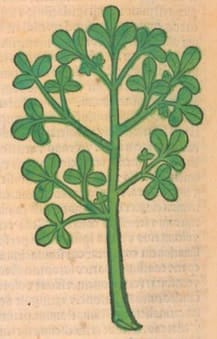
Ortus Sanitatis, Meydenbach, 1491
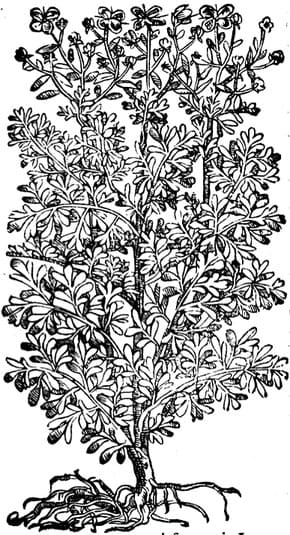
Della Materia Medicinale, Andrea Valuassori, 1562
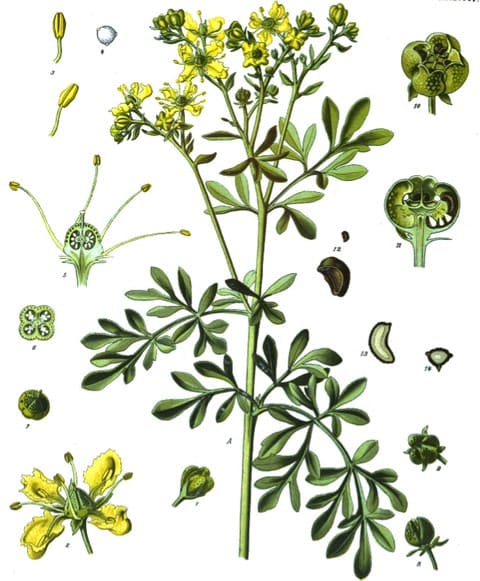
Kohler’s Medizinal Pflanzen, 1887

Botanical name:
Ruta graveolens
Parts used:
Herb; Seed
Temperature & Taste:
Warm (Cold in TCM), dry. Pungent, Bitter
Classifications:
2C INCIDERS 2D ATTENUATERS OF CONGEALED BLOOD. 2I. ANTISPASMODIC. 2K. RESOLVENT. 2M. DRAWING. 2Z. CICATRIZING
3C. ALEXIPHARMIC. 3G. EMMENAGOGUE
4h. NEPHRITIC. 4i. UTERINE. 4k. ARTHRITIC
Uses:
1. Moves the Blood, Regulates Menstruation:
-promotes menstruation when delayed, suppressed or painful
-painful, irregular Menstruation; dark or clotted menstrual blood
2. Move the Blood, clears Stasis, Eases Pain:
-bruising, stagnant or congealed blood and for all Trauma with swelling and pain.
-a special function on the Cartilage, Ligaments and Tendons; used for Sprains, Tendonitis, bone or joint pain
3. Clears Wind-Damp, Promotes Urine:
-promotes Urine in Edema or urinary obstruction
-Arthritis, Sciatica, Gout and Rheumatism (decocted in Wine)
4. Calms the Liver, Stops Wind:
–Galen noted that Rue ‘extinguishes Wind’.
-Hypertension, Tension Headaches, Palpitations with Anxiety, Hysteria, Vertigo, Dizziness
-childhood Convulsions and Epilepsy. Has been used for Infantile Convulsions in modern TCM.
5. Clears Wind, Resists Poison:
-‘The seed taken in wine, is an antidote against all dangerous medicines or Deadly poisons’. (Culpeper)
-In modern TCM, it is regarded as Cold, and is used for Wind-Heat types of Fever and Virus, as well as the Bites of Snakes, Scorpions and Centipedes. (The seeds and leaf were used for this function, the seed being preferred)
-“Counters all Poisons” (Avicenna)
6. Clears Phlegm, Resolves Swellings:
–Galen noted Rue to ‘digest all thick viscous fluids’.
-‘he hath virtue of Purging, Dissolving, and Consuming’ (A Boke of the Properties of Herbs called an Herball, 1560)
-“It dissolves Scrofula in Throat and Armpit”. (Avicenna)
7. Clears Phlegm, Stops Cough:
-cough with thick white or clear phlegm; used for chest congestion, Bronchitis, and Asthma. (West, Ayurveda)
8. Benefits the Eyesight:
-traditionally said to ‘quicken the Sight’ (Gerard); used to benefit Eyesight since Pliny.
-burning, inflamed or aching eyeballs, as well as Headaches related to Eye strain.
-weak infusion of the leaves gives much benefit when used as an eyewash.
9. Used for Melancholy:
-gently clears Melancholy Humor
-long used for Mental Illness and Insanity;
10. Warms and Strengthens the Kidneys:
-Strangury, Edema
-Traditionally said to be Aphrodisiac.
-Hernia (School of Salerno)
-Leukorrhea
11. Kills Worms:
-used for Worms for which it was often boiled in Milk; some preferred the seed for this purpose.
–Dioscorides recommended boiling in Olive oil and drinking for Worms
12. Externally:
-juice or Oil is applied to Warts and other skin growths.
-ointment, cataplasm or poultice formed by boiling the herb in Vinegar is applied to Rheumatism, Gout, Sciatica
-juice is also dropped into the ears for Earache.
-as a wash for sore, red eyes, and various eye diseases; 1 drop of the well diluted essential oil was previously dropped directly in the eye
-applied as a plaster with Barley for severe Eye pain (Dioscorides)
-oil or tincture is applied for Lethargy, Vertigo, Headache, Migraine
-oil was applied to spine in Fevers.
-good for Cold, Humid and Watery Tumors.
-decoction in wine is a good gargle for rotten Teeth and inflamed Gums.
-topically for Infection and Ulcers of the Skin, and for Eczema.
-with vinegar and Rose oil for itching (Unani)
-topically used for Cervical Cancer
-the fresh herb is beaten and applied to Venomous Bites and Stings
Dose:
Preparation:
Correctives:
Substitutes:

Main Combinations:
Calamus & Rue
1. Obstructions of the Uterus, Menstrual pain and cramping and to promote Birth, Rue with … available in PRO version
2. Promote Menstruation:
i. Rue with … available in PRO version
ii. Rue with … available in PRO version
3. Liver and Spleen obstruction, … available in PRO version
4. Cough, difficulty Breathing, pains of the sides, early stages of Edema, with … available in PRO version
5. Cough:
i. with … available in PRO version
ii. ‘dangerous cough’, with … available in PRO version
6. Loss of appetite, with … available in PRO version
7. Heart pain and Angina, with … available in PRO version
8. Anemia, with … available in PRO version
9. Preservative against infection:
i. with … available in PRO version
ii. with … available in PRO version
10. Rabies, with … available in PRO version
11. Poor or failing Eyesight … available in PRO version
12. Premature Ejaculation … available in PRO version
13. Spermatorrhea, Premature Ejaculation, with … available in PRO version
14. To quench Lust, combine with … available in PRO version
15. Swollen and inflamed Testicles from abstinence, combine with … available in PRO version
16. Leukorrhea, with … available in PRO version
17. Hernia, with … available in PRO version
18. Lameness … available in PRO version
19. Fistula in the corner of the Eye … available in PRO version
Major Formula:
Decoction of Hyssop and Rue
Cephalic Decoction (Charras)
Decoction for Cold Coughs (Nicolas Myrepsus)
Decoction of Elecampane and Rue
Decoction for Chlorosis
Syrup of Betony (Bononiense)
Syrup of Mugwort (Augustana)
Electuary of Nuts (Mithridate)
Electuary of Dates (Diaphoenicum) (Mesue)
Electuary of Hyssop (Diahyssopus) (Nicholas)
Electuary of Bayberries (Electuarium de Baccis Lauri)
Lesser Cumin Composition of Galen
Confection of Eyebright (Confectio Humain) (Mesue)
Powder of Licorice (Unani)
Powder Against Rabies
Uterine Powder (Species Hysterica)
Foetid Pills Minor of Galen
Foetid Pills Major of Galen
Foetid Pills (Mesue)
Pills to Aggregate Greater (Mesue)
Oil for Lameness
Cautions:
1. Not used during Pregnancy or when Breastfeeding (it can dry up milk)
2. Not used in Uterine Bleeding
3. Not used in Yin deficiency (very drying)
4. Some people may experience Melancholy or sleep disorders with use of Rue.
5. Phototoxicity can occur with usage of Rue.
Main Preparations used:
‘The leaves dried and burnt are used by the Hindus for the purpose of fumigating young children suffering from catarrh; they are also used fresh, bruised and mixed with arrack as an external remedy in the first stages of paralytic affections; dried and powdered they are prescribed in conjunction with aromatics in cases of dyspepsia; they are considered to be injurious to pregnant women; an opinion also entertained by Dioscorides. Rue was held in high estimation by the Greeks and Romans, and was a principal ingredient in the celebrated antidote of Mithridates. Pliny notices it in several parts of his Natural History, and calls it one of the best medicinal herbs. Celsus says of Rue, ” Urinam movet, sensus excitat, purgat, mollit.” Hippocrates considered it to be resolvent and diuretic, and notices it in his chapter on female diseases. The Arabians class Rue among their attenuentia, vesicatoria and stimulantia. The author of the Makhzan-el-Adwiya describes three kinds—garden, wild, and mountain Rue, He considers it to be hot and dry in the third degree, to increase the mental powers, to act as a tonic and digestive, and to increase the urinary and menstrual excretions. He also states that it acts as an antaphrodisiac and causes abortion when given to pregnant women. The diseases in which it is recommended are so numerous that I must refer the reader to his article “Sudab.” Early European practitioners considered Rue to be antispasmodic, stimulant and emmenagogue, and prescribed it in hysteria and flatulent colic. Boerhaave extols its virtues in promoting perspiration.
In the Schola Salerni, the following lines occur :—
“Ruta facit castuni ; dat lumen, et inherit astum.
Cocta facit ruta, de pulicibus locatuta.”
Rue is the Herb Grace of old English writers, and is still much used as a domestic remedy. Alibert says of it, “Cetto plante a un grande action sur le systeme nervenx, et particulierement sur le systeme uterin. Beaucoup de femmes en prennent dans les menstrues laborieuses.” The dose of the powdered leaves is from ten grains to a scruple or more, twice or thrice daily. Rue occupies a corner in most Bombay gardens; it grows freely, but does not generally flower.
Rue is an active irritant, whether applied externally or taken internally. It has been frequently used with success to procure abortion; sometimes it produces painful vomiting, always great prostration, confusion of mind, cloudy vision, feebleness and slowness of pulse, coldness of the extremities, and twitching of the limbs; in pregnant women the drug produces pain in the back, bearing down, and frequent micturition, followed by pains and abortion about ten days after the commencement of its administration. Oil of Rue has been observed to produce similar symptoms with increased frequency and diminished tension of the pulse; on the other hand, when an infusion of the dry leaves was used, the pulse fell from 80 to 69 in three hours.— (Van de Warker, Criminal Abortion, 1872.) (Vegetable Materia Medica of Western India, Dymock, 1885)
GENERAL / REVIEW
–Genus Ruta: A natural source of high value products with biological and pharmacological properties.
–Identity and pharmacognosy of Ruta graveolens
ANTIBACTERIAL:
–Determination of antibacterial activity and metabolite profile of Ruta graveolens against Streptococcus mutans and Streptococcus sobrinus.
–Chemical composition and antimicrobial activity of the essential oils from four Ruta species growing in Algeria.
–Antimicrobial and cytotoxic activity of Ruta graveolens.
ANTI-FUNGAL:
–Algicidal and antifungal compounds from the roots of Ruta graveolens and synthesis of their analogs.
–Natural fungicides from Ruta graveolens L. leaves, including a new quinolone alkaloid.
–active against Colletotrichum, Fusarium, Botrytis, and especially Phomopsis species. (Tan et al., Planta Med, Feb 1999; Oliva et al., J Agric Food Chem, Feb 2003)
ANTI-INFLAMMATORY:
–Antinociceptive, anti-inflammatory and antipyretic activities of the leaf methanol extract of Ruta graveolens L. (Rutaceae) in mice and rats.
–Oral administration of alkaloid fraction from Ruta graveolens inhibits oxidative stress and inflammation in hypercholesterolemic rabbits.
–Anti-inflammatory effect of quinoline alkaloid skimmianine isolated from Ruta graveolens L.
–Protective effects of isolated polyphenolic and alkaloid fractions of Ruta graveolens L. on acute and chronic models of inflammation.
–Methanolic extract of Ruta graveolens L. inhibits inflammation and oxidative stress in adjuvant induced model of arthritis in rats.
–Anti-inflammatory effect of Ruta graveolens L. in murine macrophage cells.
–Phytochemical Characterization, and Antioxidant and Antimicrobial Properties of Agitated Cultures of Three Rue Species: Ruta chalepensis, Ruta corsica, and Ruta graveolens.
ANTI-OXIDANT:
–Oral administration of alkaloid fraction from Ruta graveolens inhibits oxidative stress and inflammation in hypercholesterolemic rabbits.
–Methanolic extract of Ruta graveolens L. inhibits inflammation and oxidative stress in adjuvant induced model of arthritis in rats.
–Extraction of antioxidants from plants using ultrasonic methods and their antioxidant capacity.
ANTI–PYRETIC:
–Antinociceptive, anti-inflammatory and antipyretic activities of the leaf methanol extract of Ruta graveolens L. (Rutaceae) in mice and rats.
ANTI-HYPERTENSIVE:
–The cardiovascular effects of green beans (Phaseolus aureus), common rue (Ruta graveolens), and kelp (Laminaria japonica) in rats.
–Ruta Montana Evokes Antihypertensive Activity Through an Increase of Prostaglandins Release in L-NAME-Induced Hypertensive Rats.
ANTI-ULCER:
–Protective effect of hydro-alcoholic extract of Ruta graveolens Linn. leaves on indomethacin and pylorus ligation-induced gastric ulcer in rats.
ANTI-TUMOR:
–Anti-tumour activity of Ruta graveolens extract.
ANTI-CANCER:
–Therapeutic management of peritoneal ascitic sarcomatosis by Ruta graveolens: A study in experimental mice.
–Ruta graveolens extract induces DNA damage pathways and blocks Akt activation to inhibit cancer cell proliferation and survival.
T-CELL LEUKEMIA / LYMPHOMA
–Screening of promising chemotherapeutic candidates from plants against human adult T-cell leukemia/lymphoma (V): coumarins and alkaloids from Boenninghausenia japonica and Ruta graveolens.
BREAST:
–Antiproliferative Effects of Various Furanoacridones Isolated from Ruta graveolens on Human Breast Cancer Cell Lines.
BRAIN CANCER / GLIOBLASTOMA
–Ruta graveolens L. induces death of glioblastoma cells and neural progenitors, but not of neurons, via ERK 1/2 and AKT activation.
MELANOMA:
–Evaluation of chemopreventive potentials of ethanolic extract of Ruta graveolens against A375 skin melanoma cells in vitro and induced skin cancer in mice in vivo.
–Graveoline isolated from ethanolic extract of Ruta graveolens triggers apoptosis and autophagy in skin melanoma cells: a novel apoptosis-independent autophagic signaling pathway.
ANTI-ASTHMATIC:
–Medicinal Plants for the Treatment of Asthma: A Traditional Persian Medicine Perspective.
HORMONAL EFFECT:
–“Not tonight zebrafish”: the effects of Ruta graveolens on reproduction.
ANTI-ANDROGENIC:
–Antiandrogenic activity of Ruta graveolens L in male Albino rats with emphasis on sexual and aggressive behavior.
ANTI-FERTILITY EFFECT:
–“Not tonight zebrafish”: the effects of Ruta graveolens on reproduction.
–New quinoline alkaloid from Ruta graveolens aerial parts and evaluation of the antifertility activity.
–Post-coital antifertility action of Ruta graveolens in female rats and hamsters.
–Antifertility principle of Ruta graveolens.
CONTRACEPTIVE EFFECT:
–Medicinal Plants Used in Iranian Traditional Medicine (ITM) as Contraceptive Agents.
–Immobilising effect of Ruta graveolens L. on human spermatozoa: coumarin compounds are involved.
–Acute Effects of Ruta graveolens L. on Sperm Parameters and DNA Integrity in Rats.
–Immobilization effect of Ruta graveolens L. on human sperm: a new hope for male contraception.
–Effect of Ruta graveolens and Cannabis sativa alcoholic extract on spermatogenesis in the adult wistar male rats.
ENHANCE LEARNING & MEMORY
–Ruta graveolens and rutin, as its major compound: investigating their effect on spatial memory and passive avoidance memory in rats.
ENHANCE NERVE GROWTH FACTOR:
–Enhancement of the nerve growth factor-mediated neurite outgrowth from PC12D cells by Chinese and Paraguayan medicinal plants.
–Rue markedly increases Nerve Growth Factor (NGF). (Biol. Pharm. Bull. July 1999)
NEUROPROTECTIVE / NEURORESTORATIVE
–Ruta graveolens as a potential source of neuroactive compounds to promote and restore neural functions
MULTIPLE SCLEROSIS:
–Efficacy and Tolerability of Phytomedicines in Multiple Sclerosis Patients: A Review.
ANTI-DIABETIC:
–Ethanol extracts of Herba Rutae increased glucose utilisation in muscle cells (137% increase). (van Huyssteen et al., Afr J Trad. Complement Altern Med., 2011)
SIGNIFICANTLY INCREASED BODY WEIGHT:
–Herba Ruta significantly increased body weight and total food intake, as well as a significant increase in protein efficiency following oral intake of the ether extract (500mg/ kg) to growing rats over a 3 week period. A marked increase in alkaline phosphatase was also noted. (Al-Okbi et al., Indian J Exp Biol, Jan 2002)
ANTI-TRYPANOSOMIASIS:
–Potential therapeutic use of herbal extracts in trypanosomiasis.
SCHISTOSOMIASIS
–In Vitro Schistosomicidal Activity of the Alkaloid-Rich Fraction from Ruta graveolens L. (Rutaceae) and Its Characterization by UPLC-QTOF-MS.