Sanguis Draconis, Dragon’s Blood, Xue Jie 血竭
Xue Jie (TCM)
Damm ul Akhwain (Unani)
Raktaniryaas, Khoon-kharaabaa (Daemonorops draco, Ayurveda)
Khoonkharaba, Heeradokhi (Dracaena cinnabari, Ayurveda)

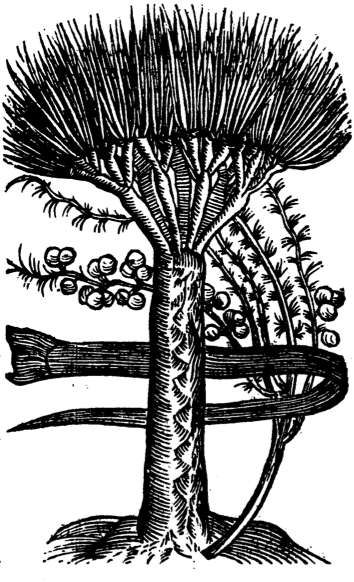
Traditional source of Dragon’s Blood according to
Parkinson, Theatrum Botanicum, 1640
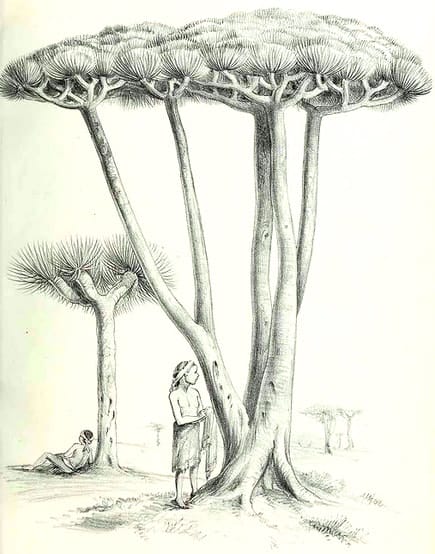
Dracaena cinnabari
Balfour, I.B., Botany of Socotra, 1888
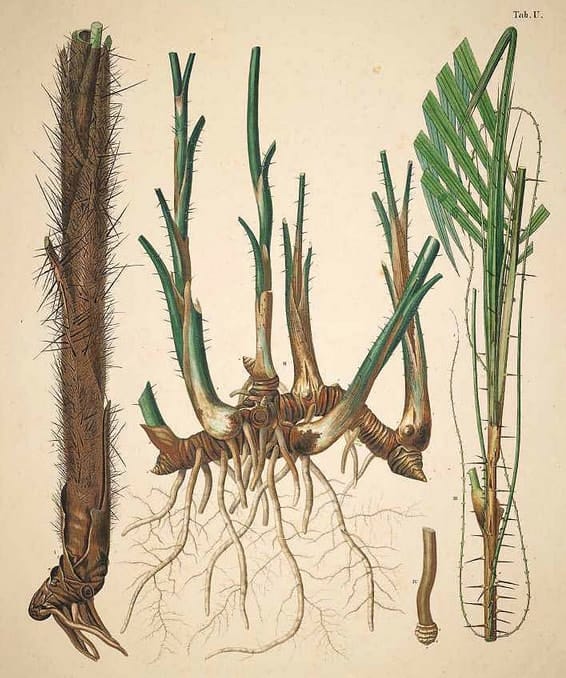
Daemonorops draco (syn. Calamus draco)
Martius, C.F.P. von, Historia Naturalis Palmarum, 1826
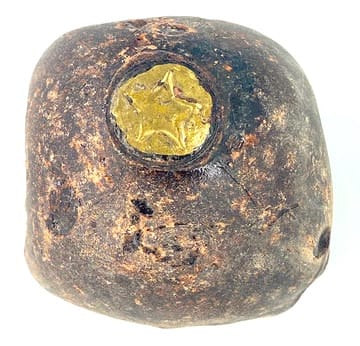
A ball of Dragon’s Blood with a Gold Star Seal
(Adam, 2022)

Botanical name:
Daemonorops draco (syn. Calamus draco, D. adscendens);
Other species are also used. Various other plants have supplied Dragon’s Blood too.
Parts used:
Gum-resin
Temperature & Taste:
Cool, dry. Sweet, Salty.
Classifications:
2G. CLEANSING 2N. REPELLENTS 2O. ASTRINGENTS 2P. HEMOSTATICS 2T. GLUTINATE 2X. INCARNATIVE 2Z. CICATRIZING
4e. STOMACHIC
Uses:
1. Moves the Blood, Clears Stasis, Eases Pain (West, TCM, Unani):
-pain related to blood stagnation or internal bruising as seen in Trauma, Fractures, Sprains, or from other causes.
2. Stops Bleeding (West, TCM, Unani):
-In Europe, it was taken for Diarrhea and Dysentery, especially with Blood;
-Spitting of Blood, excess Menstruation
-considered specific for all types of Bleeding in Unani
-applied externally to stop bleeding from wounds.
-“It causes constipation and stops bleeding”. (Avicenna)
3. Strengthens the Stomach:
-“It strengthens the Stomach”. (Avicenna)
4. Externally:
-topically as a powder to stop Bleeding
-“Dragon’s blood heals fresh Ulcers and Wounds”. (Avicenna)
-powder is applied to chronic non-healing Wounds and Ulcers to help protect, prevent decay and aid healing. (TCM, West)
-fastens loose Teeth
-more recently, it has been used for its anti-fungal effect.
Dose
In Pills or Powder: 500mg–3 grams
Correctives:
Substitutes:

Main Combinations:
1. Trauma, Bruising:
i. Dragon’s Blood with … available in PRO version
ii. Dragon’s Blood with … available in PRO version
iii. Dragon’s Blood with … available in PRO version
iv. Dragon’s Blood with … available in PRO version
v. Dragon’s Blood with … available in PRO version
2. To stop Bleeding:
i. Dragon’s Blood with … available in PRO version
ii. Dragon’s Blood with … available in PRO version
iii. Dragon’s Blood with … available in PRO version
3. Kidney and Bladder Ulcers:
i. Dragon’s Blood with … available in PRO version
ii. Dragon’s Blood with … available in PRO version
4. Non-healing Wounds and Ulcers, Dragon’s Blood with … available in PRO version
5. Heat of the Eyes, Dragon’s Blood with … available in PRO version, Mastic, Roses, made into a paste with Egg white, Vinegar and Rose water, apply to temples and forehead.
6. As an ointment for Hemorrhoids, Dragon’s Blood with … available in PRO version
Major Formulas:
Powder for Hemoptysis (Galen)
Powder to Break Blood Above and Below (Nicholas)
Powder to Move Blood (Wirtzung)
Powder of Amber (Unani)
Powder for Excess Menstruation (Serapion)
Troches of Gordon (Trochisci Gordonii)
Astringent Pills
Tincture for Blood Stagnation
Qi Li San (TCM)
Zhen Xiang Jiao Nag (Precious Aromatic Capsules) (TCM)
Die Da Wan
Cautions:
1. Not used during Pregnancy
2. Not used in marked weakness
3. Long-term use harms the Kidneys according to Unani.
Main Preparations used:
Purified Gum
‘The substance which is mentioned by Dioscorides under the name of [?], as a costly pigment and medicine brought from Africa, and which is also described by Pliny who distinguished it from minium, was certainly the resin called Dragon’s Blood. It was not however that of the Rotang Palm, Calamus Draco, or even of any tree of the Indian Archipelago, but was on the contrary a production of the island of Socotra.
Dragon’s blood is, we believe, not named by any of the earlier voyagers to the India islands. Ibn Batuta, who visited both Java and Sumatra between A.D. 1325 and 1349, and notices their producing benzoin, cloves, camphor, and aloes-wood, is silent about dragon’s blood. Barbosa, whose intelligent narrative (A.D. 1514) of the East Indies is full of reference to the trade and productions of the different localities he visited, states that aloes and dragon’s blood are produced in Socotra, but makes no mention of the latter commodity as found at Malacca, Java, Sumatra, or Borneo.
The fact we wish to prove is corroborated by the accounts of early commercial intercourse between the Chinese and Arabs recently published by Bretschneider.
From the 10th to the 15th century there was carried on between these nations a trade, the objects of which were not only the productions of the Arabian Gulf and countries further north, but also those of the Indian Archipelago. One of the islands with which the Arabs and Persians carried on a great commerce was Sumatra, whence they obtained the precious camphor so much valued by the Chinese, but not, so far as it appears, the resin dragon’s blood. As to the productions brought from Arabia they are enumerated as Ostriches, Olibanum, Liquid Storax, Myrrh, and Dragon’s Blood, besides a few other articles not yet determined. It is worthy of remark that the Chinese are still the principal consumers of dragon’s blood, though like the rest of mankind they have to content themselves with the plentiful drug of Sumatra and Borneo, instead of the more ancient sort produced in Socotra.
The first clear account of the production of the resin in India is that given by Rumphius, who in his Herbarium Amboinense describes the process by which it is collected at Palembang.’ (Pharmacographia, Fluckiger & Hanbury, 1879)
GENERAL / REVIEW
–Exploring the historical distribution of Dracaena cinnabari using ethnobotanical knowledge on Socotra Island, Yemen.
–Phenolic constituents, pharmacological activities, quality control, and metabolism of Dracaena species: A review.
–Dragon’s blood secretion and its ecological significance.
–[New study on species of Chinese medicine dragon’s blood].
–Comparison of the chemical profiles and anti-platelet aggregation effects of two “Dragon’s Blood” drugs used in traditional Chinese medicine.
–Phytochemistry and Pharmacological Activities of Dracaena cinnabari Resin.
ANTIBACTERIAL
–Anti-inflammatory, pro-proliferative and antimicrobial potential of the compounds isolated from Daemonorops draco (Willd.) Blume.
–Bioprotective properties of Dragon’s blood resin: in vitro evaluation of antioxidant activity and antimicrobial activity.
–Search for antibacterial and antifungal agents from selected Indian medicinal plants.
ANTI-FUNGAL:
–Ethnobotanical Survey of Dracaena cinnabari and Investigation of the Pharmacognostical Properties, Antifungal and Antioxidant Activity of Its Resin.
ANTI-VIRAL:
–HEPATITIS: Isolation and Characterization of Two Chalcone Derivatives with Anti-Hepatitis B Virus Activity from the Endemic Socotraen Dracaena cinnabari (Dragon’s Blood Tree).
–INFLUENZA: Phytochemical screening and antiviral activity of some medicinal plants from the island Soqotra.
ANTI-INFLAMMATORY
–Anti-inflammatory, pro-proliferative and antimicrobial potential of the compounds isolated from Daemonorops draco (Willd.) Blume.
–Anti-inflammatory Flavan-3-ol-dihydroretrochalcones from Daemonorops draco.
ANTIOXIDANT:
–Ethnobotanical Survey of Dracaena cinnabari and Investigation of the Pharmacognostical Properties, Antifungal and Antioxidant Activity of Its Resin.
–Bioprotective properties of Dragon’s blood resin: in vitro evaluation of antioxidant activity and antimicrobial activity.
ANTICOAGULANT
–Isolation and anticoagulant properties of polysaccharides of Typha Augustata and Daemonorops species.
ANTIPLATELET
–Antiplatelet activity of loureirin A by attenuating Akt phosphorylation: In vitro studies.
–Comparison of the chemical profiles and anti-platelet aggregation effects of two “Dragon’s Blood” drugs used in traditional Chinese medicine.
NEURODEGENERATIVE DISEASE
–Natural potential therapeutic agents of neurodegenerative diseases from the traditional herbal medicine Chinese dragon’s blood.
ALZHEIMER’S DISEASE
–Dihydrochalcone molecules destabilize Alzheimer’s amyloid-β protofibrils through binding to the protofibril cavity.
RADIOPROTECTIVE
–Radioprotective effects of dragon’s blood and its extracts on radiation-induced myelosuppressive mice.
ANTI-PROLIFERATIVE
–Anti-inflammatory, pro-proliferative and antimicrobial potential of the compounds isolated from Daemonorops draco (Willd.) Blume.
ANTI-PARASITIC:
–Assessment of the in vitro antiprotozoal and cytotoxic potential of 20 selected medicinal plants from the island of Soqotra.
ANTI-TUMOR
–In vitro screening for the tumoricidal properties of international medicinal herbs.
ANTI-CANCER
–Daemonorops draco Blume Induces Apoptosis Against Acute Myeloid Leukemia Cells via Regulation of the miR-216b/c-Jun.
–The in vitro and in vivo antitumor effects of Dracaena cinnabari resin extract on oral cancer.
–Prevention of oral carcinogenesis in rats by Dracaena cinnabari resin extracts.
–Cell Cycle Arrest and Apoptosis Induction via Modulation of Mitochondrial Integrity by Bcl-2 Family Members and Caspase Dependence in Dracaena cinnabari-Treated H400 Human Oral Squamous Cell Carcinoma.
WOUND HEALING
–Dracorhodin perchlorate enhances wound healing via β-catenin, ERK/p38, and AKT signaling in human HaCaT keratinocytes.