Sarracenia, Pitcher Plant
Indian Cup, Small-Pox Plant, Saddle plant, Side-Saddle plant
Huang Ping Zi Cao (S. flava, Yellow Pitcherplant)
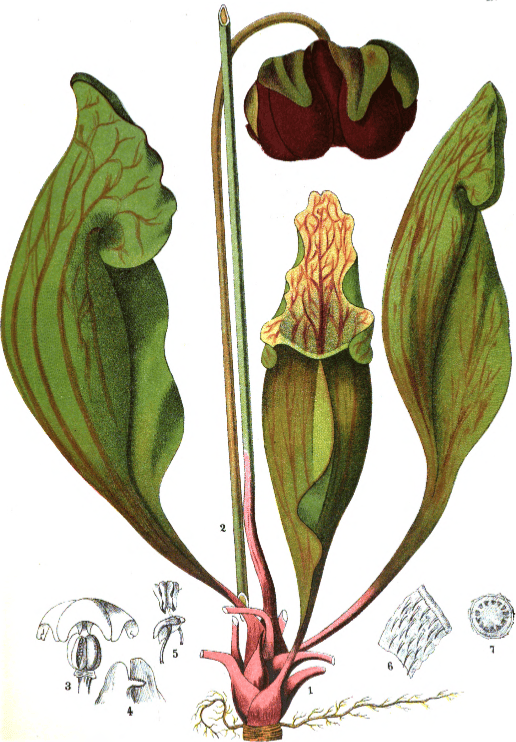
Sarracenia spp.
Medicinal Plants, Millspaugh, 1892
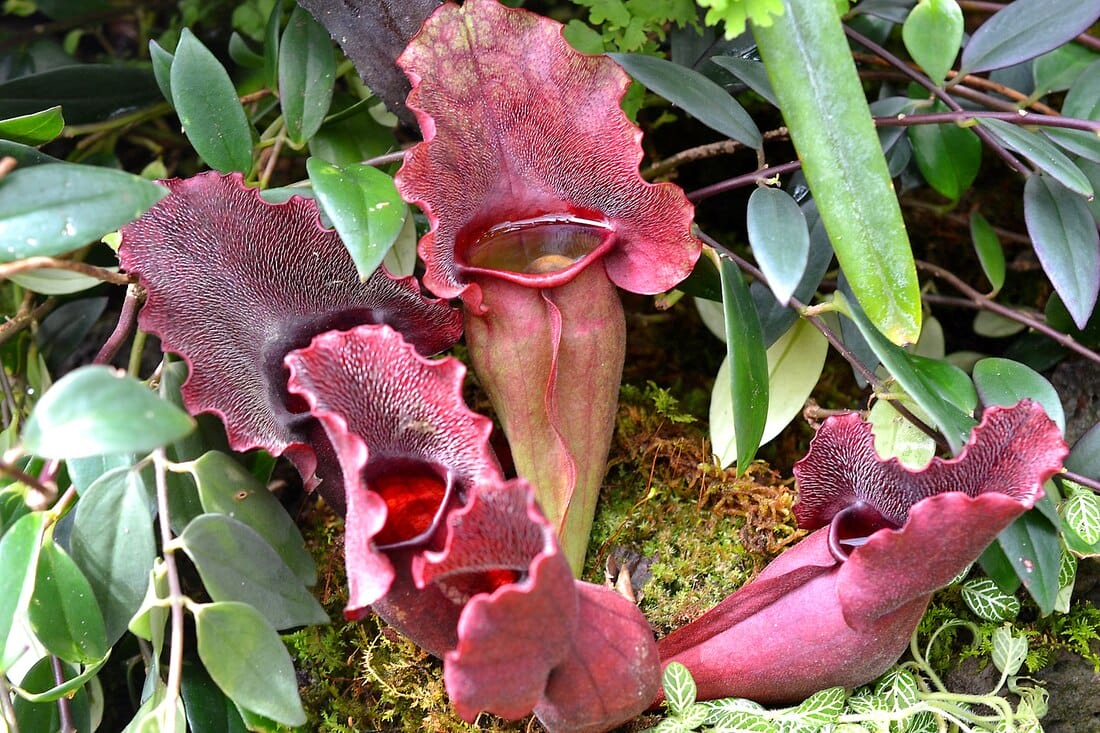
Sarracenia purpurea
(Photo by incidencematrix) (Wikimedia)
Botanical name:
Sarracenia spp.
- S. purpurea (most commonly used species)
- S. flava
- S. variolatus
Some claimed the only active species was S. pururea (Morris), while others suggested a number of other species probably possess similar properties including: S. heterophylla, S. flava, S. rubra, S. variolatus, S. drummondii, S. psyttacina (King). The three species listed above were generally regarded as equivalent in effect, with the other species listed by King are probably also equivalent.
Parts used:
Many authorities recommended using only the fresh plant.
Whole fresh plant when budding, before the leaves have fully expanded, or the fresh root gathered after fruiting.
King said the leaf was equally effective as the root, and also recommended the powder.
Temperature & Taste:
Cold, dry. Bitter, slightly Sour
Constituents:
Piperidine Alkaloids: sarracenin (similar to veratrin), coniine, gamma-conicein
Sarracenia acid
Tannin, resin
Uses:
1. Clears Wind-Heat, Resists Poison:
-Measles, Chicken Pox, Small Pox
-prophylactic in Small Pox (King’s)
2. Clears Damp-Heat, Promotes Urine:
-Heat and Damp affecting the Stomach, Liver or Intestines
-obstructed Urine
-Indigestion
3. Moves the Blood, Promotes Menstruation:
-Chlorosis, Amenorrhea
Dose:
Powder: 1–2 grams (20–30 grains–King’s), 3–4 times daily.
Infusion: 1–3 fluid ounces, or 1 oz. to a pint, taken in teacupful doses.
Tincture of the Fresh Plant (1 in 5): 1 fluid dram
Fluid Extract: 10–20 drops
Comment:
A number of authors regarded this as specific for Small Pox, both to prevent and to cure (for example, Family Botanic Guide, Fox, 1924). However others, and specifically many European practitioners found it to be inert, and certainly ineffective against Small Pox. This was almost certainly due to the dry material being too old and therefore to have lost its strength. This led some to say only the fresh plant or root should be employed to make a Tincture or Fluid Extract. However, others (King’s) regarded the powder as effective. We may therefore assume fresh and dried products to be effective, as long as the dried product is freshly dried and prepared. In any case, the fresh plant or root appears to be more certain and effective, and therefore, should be used where possible. A number of modern sources (including PDR for Herbal Medicines) regard it as obsolete.
Main Combinations:
1. Promote Menstruation, Pitcher plant (Sarracenia), Blue Cohosh
2. Chicken Pox, Calendula with Pitcher plant (Sarracenia), Pennyroyal (1 oz. each), Senna (half oz.). Steep in 3 pints of boiling water and drink freely. (Family Botanic Guide, Fox, 1924)
Major Formulas:
Cautions:
None noted. The plant is said to contain traces of the toxic alkaloid Coniine (Hoffman).
Main Preparations used:
GENERAL / REVIEW
–Secondary Metabolites with Biomedical Applications from Plants of the Sarraceniaceae Family.
–Phytochemical Comparison of the Water and Ethanol Leaf Extracts of the Cree medicinal plant, Sarracenia purpurea L. (Sarraceniaceae).
–Phytochemical constituents of Sarracenia purpurea L. (pitcher plant).
ANTIOXIDANT
–Anticancer and Antioxidant Activities of the Root Extract of the Carnivorous Pitcher Plant Sarracenia purpurea.
ANTI-MYCOBACTERIAL
–Antimycobacterial triterpenes from the Canadian medicinal plant Sarracenia purpurea.
ANTI-VIRAL
–In vitro evaluation of antiviral activity in carnivorous plant species.
–Natural Immunomodulatory Agents as a Complementary Therapy for Poxviruses.
–Anti-herpes virus activity of the carnivorous botanical, Sarracenia purpurea.
DIGESTIVE ENZYMES
–Discovery of digestive enzymes in carnivorous plants with focus on proteases.
DIABETES
–Antidiabetic compounds from Sarracenia purpurea used traditionally by the Eeyou Istchee Cree First Nation.
CYTOPROTECTIVE
–Characterizing the cytoprotective activity of Sarracenia purpurea L., a medicinal plant that inhibits glucotoxicity in PC12 cells.
CANCER
–Anticancer and Antioxidant Activities of the Root Extract of the Carnivorous Pitcher Plant Sarracenia purpurea.
LUNG
–Inhibition of RPA32 and Cytotoxic Effects of the Carnivorous Plant Sarracenia purpurea Root Extract in Non-Small-Cell Lung Cancer Cells.
MELANOMA
–The Inhibitory Effects and Cytotoxic Activities of the Stem Extract of Sarracenia purpurea against Melanoma Cells and the SsbA Protein.